
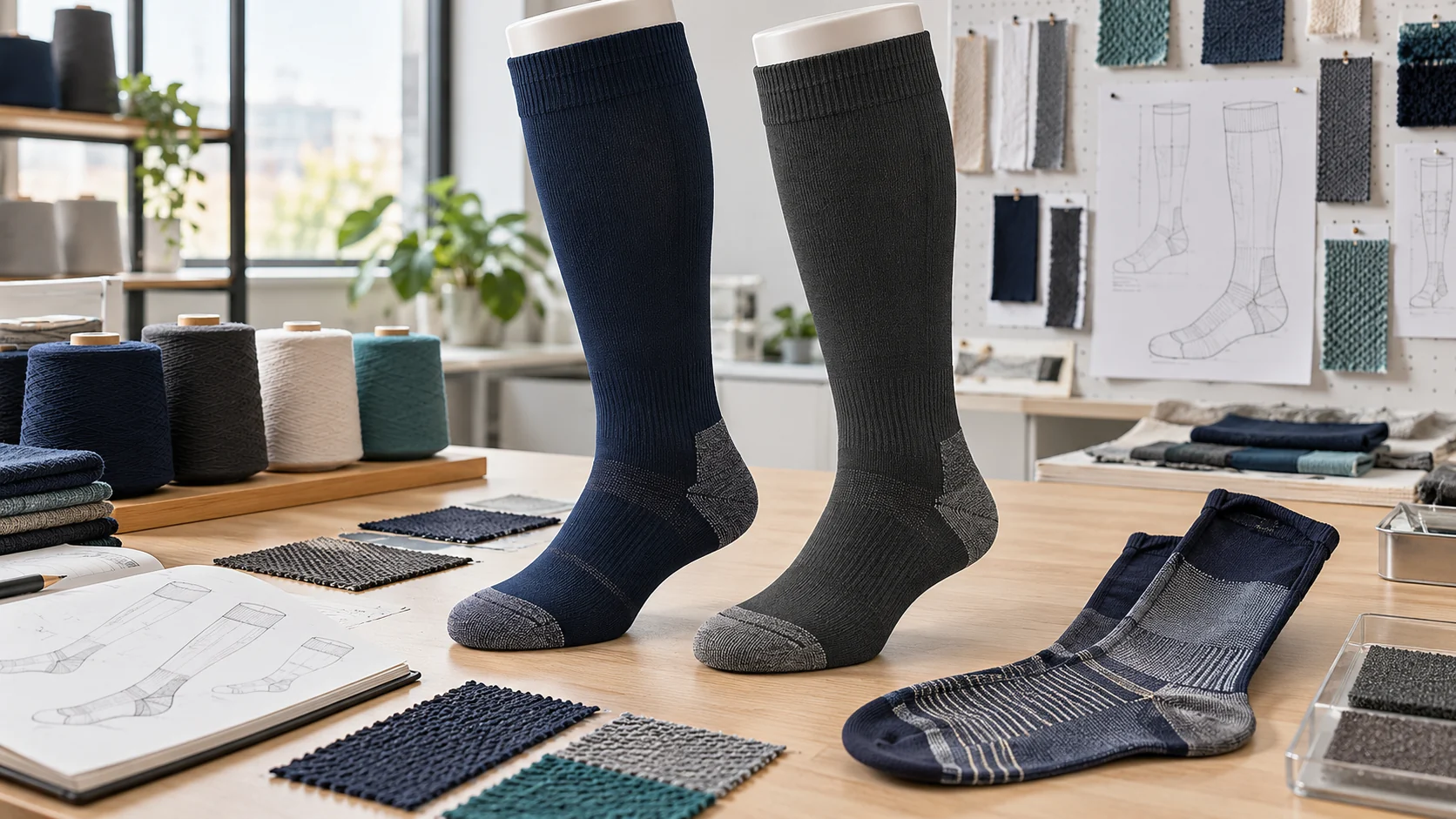
Concept visualization for product-development discussion. Confirm yarn availability, reinforcement construction, compression and manufacturing feasibility before presenting this style as available.
Heel and toe wear is a practical concern for wholesalers, uniform suppliers and private label sellers planning repeat-use compression socks. A reinforcement brief can address the zones that experience frequent friction, but adding more yarn is not a complete specification. The design must still fit inside the intended footwear, maintain a smooth toe area and work across the full plus size grading plan.
This guide gives buyers a structured way to discuss a reinforced heel and toe program with a supplier. It focuses on measurable design choices and approval steps rather than making an untested durability promise.
Map the high-wear zones before choosing a construction
Start by marking the exact area to reinforce on a technical drawing. A heel zone may include the heel pocket, the lower back of the heel or a transition into the sole. A toe zone may cover the tip, underside or a short distance behind the toe closure. “Reinforced foot” is too broad if the buyer and manufacturer picture different areas.
The intended use matters. Dress shoes, work footwear, nurse shoes and everyday trainers create different friction points and space limits. Ask sample wearers to note where rubbing occurs, then compare those observations with visible wear after the agreed trial period. The result can guide a more focused construction.
Select reinforcement yarn and stitch density together
Reinforcement can come from yarn selection, plating, an adjusted stitch structure or a combination of these methods. A denser-looking area is not automatically better. It may add stiffness, reduce local stretch or create a noticeable transition line. Buyers should request the proposed yarn and knit method in the sample specification.
Compare the reinforced zone with the main foot fabric for thickness, hand feel, stretch and visual appearance. If a contrasting color is used to communicate reinforcement, approve the color placement separately from performance. For a more general construction review, see the toe seam and cuff construction guide.
Protect toe comfort while developing the reinforced area
The toe closure and the reinforcement panel are two connected details. Extra yarn near the closure can create bulk if the overlap is not controlled. Review the sock both right-side-out and inside-out, checking the seam or linking line for ridges, loose ends and abrupt changes in thickness.
A reinforced toe does not have to mean a bulky toe. Define the reinforcement boundary and keep the closure method in the approval checklist. Buyers comparing smoother constructions can also review the seamless toe plus size compression socks OEM guide.
Check shoe volume with the final foot construction
Additional yarn changes the volume of the foot section even when the leg looks unchanged. Test the approved sample in the footwear category named in the product brief. A sock for business shoes may require a lower-profile reinforcement than a design intended for roomier work or casual footwear.
Check the largest planned foot size as well as an average size. The same construction can feel different when the foot fabric is stretched to a wider or longer boundary. If cushioning is added as a separate feature, use the terry sole development guide to avoid combining unmeasured bulk changes.
Keep the wide-calf grading plan connected to foot sizing
Plus size compression socks may need more than a single linear size increase. Foot length, ankle, calf circumference and finished height should be graded as a system. Reinforcement placement must still align with the heel and toe after grading, especially where the range includes different foot-to-calf proportions.
Record relaxed measurements and the agreed fit measurements for each sample size. During fitting, check heel-pocket alignment, toe coverage, ankle smoothness, calf expansion and cuff position. If the reinforced areas migrate away from the intended zones, update placement rather than approving appearance alone.
Build a sample test plan around the claim you want to make
Do not publish a statement such as “lasts twice as long” without a defined comparison and supporting evidence. A safer development approach is to document what was tested: the final yarn combination, sample size, footwear or abrasion method, number of wash cycles and acceptance criteria.
- Inspect the starting sample for reinforcement placement and defects.
- Measure the foot, heel pocket and toe section before testing.
- Use the agreed abrasion or wear-test method on the finished construction.
- Repeat appearance and dimension checks after laundering.
- Review pilling, thinning, holes, seam condition and yarn exposure.
- Check stretch and recovery at the foot, ankle and calf.
- Retain a labeled approval sample for bulk comparison.
The wash and stretch-recovery testing guide provides a related framework for recording dimensional changes.
Translate the approved sample into bulk quality control
Bulk inspection should use the approved physical sample and written specification together. Define how reinforcement placement will be measured, which dimensions are critical and what appearance variation is acceptable. Inspect more than the visible color block: heel alignment, toe closure, loose yarns and transition smoothness can affect the user experience.
Sampling level, tolerances and defect classification should be agreed before production. Keep lot and packaging information traceable to the inspection record. Buyers can use the bulk order quality-control guide to structure the wider inspection plan.
Use precise, supportable packaging language
Packaging can identify “reinforced heel and toe” when the finished product matches that construction. Avoid turning the feature into a quantified service-life claim unless the evidence supports the wording and comparison. Clear sizing, fiber composition, care instructions and the intended product category are more useful to a wholesale buyer than vague superlatives.
For an OEM inquiry, provide the target market, footwear type, size range, compression target, reinforcement zones, preferred colors and planned packaging. Explore custom compression sock development or send the completed brief through the quote form.
FAQ
Does reinforcement automatically make a compression sock more durable?
No. Yarn, stitch density, fit, footwear friction, finishing and laundering can all affect wear. Test the finished construction before making a durability claim.
Should the heel and toe use the same reinforcement construction?
Not necessarily. Each zone has different movement, friction and fit requirements, so buyers can approve separate targets.
Can reinforcement change shoe fit?
Yes. Added yarn or cushioning can increase bulk. Test samples in the intended footwear across the planned foot-size range.
What should a bulk inspection check?
Check placement, dimensions, appearance, toe closure, stretch recovery and consistency against the approved sample and written specification.