
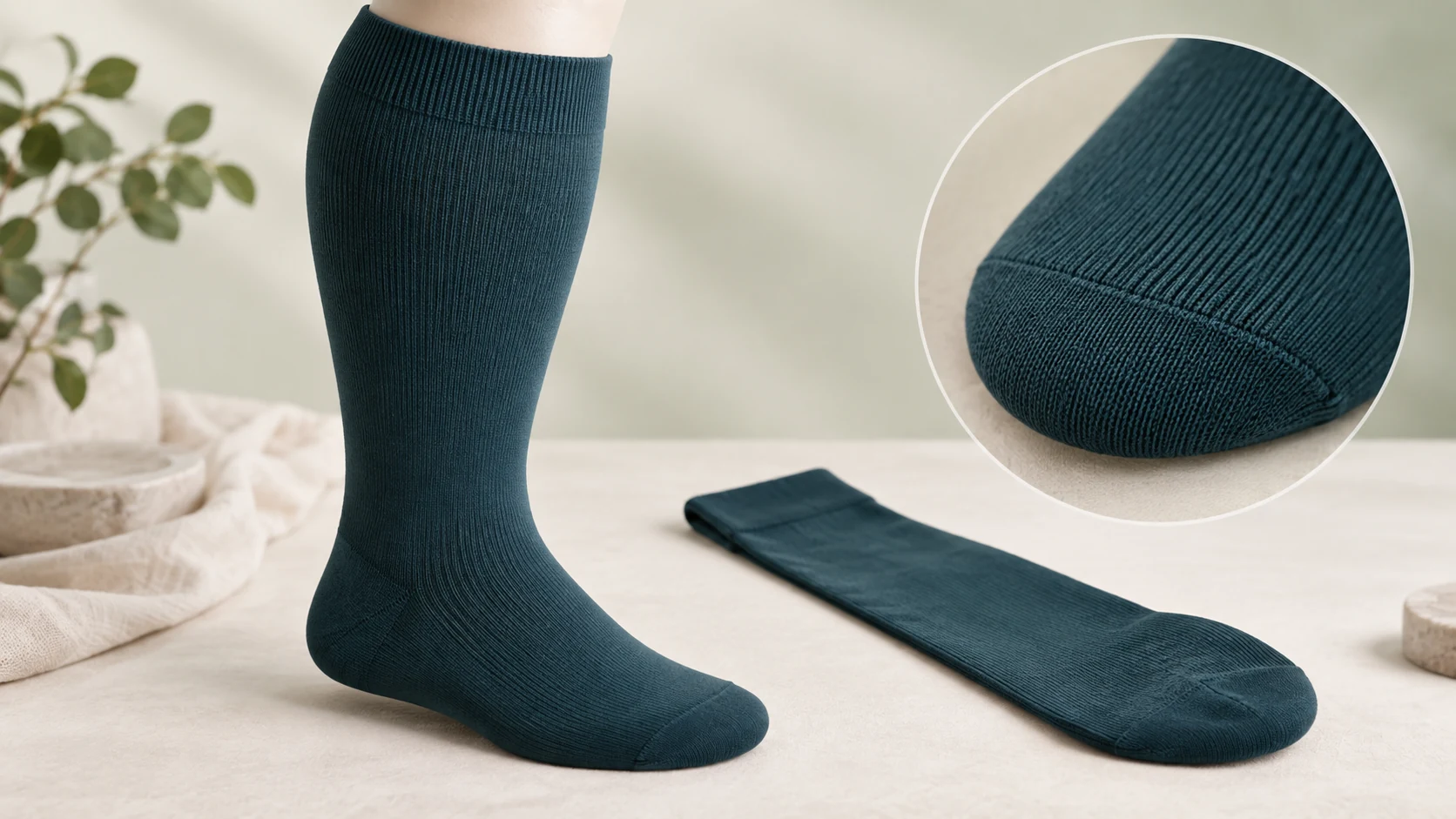
Concept visualization for product-development discussion. Confirm the actual closure method, production feasibility and approved sample before presenting this construction as available.
A toe seam occupies only a small part of a compression sock, yet it can shape the entire wearing experience inside a shoe. For a plus size program, the closure must work with a broader forefoot, a correctly placed heel and a knee-high body graded for larger ankles and calves. A smooth-looking sample is not enough if the foot length, toe depth or compression profile changes across the size range.
This guide is written for brands, wholesalers, uniform suppliers and private label buyers developing seamless toe plus size compression socks. It focuses on specifications and approval checks rather than medical outcomes. Buyers should confirm equipment, closure options, materials, MOQ, sample timing and testing feasibility with the supplier before making availability claims.
What does “seamless toe” mean in an OEM specification?
The word seamless is used differently across the sock industry. It may describe a hand-linked or machine-linked closure, a very flat seam, or simply a seam positioned to reduce a prominent ridge. Most closed-toe socks still need a method for joining the toe. The commercial label therefore should not replace a construction reference.
Ask the supplier to identify the proposed closing process and provide an inside-out sample. Define what the buyer expects to see and feel: closure position, ridge height, width, stretch, yarn ends and the transition at both sides of the toe. If a particular linked construction is required, include it in the approved specification rather than relying on the word seamless.
Why plus size foot grading matters
Wide-calf compression socks are often discussed through ankle and calf circumference, but the foot still needs its own grade. A larger calf does not always correspond to a longer or wider foot. Reusing one foot across too many leg sizes can create excess toe fabric in one size and a short, tight toe box in another.
Review foot length, forefoot circumference, toe-box depth, heel-to-toe length and heel placement together. The smallest and largest sizes deserve separate samples. For a broad 2XL-7XL assortment, buyers may need more than one foot form across the calf range.
- Target shoe-size system and foot-length range.
- Forefoot width or circumference at the widest point.
- Toe-box depth and finished toe shape.
- Heel-to-ankle position and total sole length.
- Ankle, calf, below-knee and leg-length measurements.
The ankle, calf and foot grading guide provides a broader framework for coordinating these measurements.
Keep toe comfort and compression as separate specifications
A flatter closure does not define the compression level. The pressure profile is created by yarn, knitting structure, circumference and finishing across the foot, ankle and leg. Buyers should specify where the measurable compression zone begins and how the toe box transitions into the forefoot.
Do not copy a pressure statement from another style without checking the new finished construction. If the foot pattern, yarn or knitting tension changes, verify performance using the agreed method and test points. Record the test condition, size and acceptance range so later production can be compared with the approved sample.
Choose the toe shape for the target footwear
A flat closure can still feel uncomfortable if the toe box is too narrow, too shallow or badly aligned. Define the footwear and channel before sampling. Nurse and workwear buyers may prioritize compatibility with closed work shoes, while travel and daily-wear programs may use different shoe volumes.
Wear-test the sock inside representative footwear. Check whether the closure sits across the top, front or underside of the toes, whether it shifts during walking and whether extra fabric folds at the sides. The approved seam position should remain stable across sizes rather than drifting as the foot is graded.
Material and closure yarn decisions
The body yarn and closing yarn need compatible stretch, recovery and wash behavior. A closure yarn that feels soft initially may relax differently from the knitted toe, while a strong yarn can create a harder ridge if tension is not controlled. Color matching also matters when the closing yarn remains visible on the outside.
Approve the complete finished sock, not only a yarn card. If the product uses a soft-touch, cooling or moisture-management positioning, verify those statements separately. Toe construction alone does not prove breathability, moisture movement or any health benefit.
What to include in the sample brief
- Reference photo and name of the required toe closure method.
- Inside and outside appearance expected after linking.
- Foot, forefoot, ankle, calf and leg-length size table.
- Compression specification, test method and measurement points.
- Body yarn, closure yarn, color and wash-care requirements.
- Target footwear and intended distribution channel.
- Acceptable toe shape, closure alignment and yarn-end finish.
- Logo, color, packaging and customer-facing terminology.
Ask whether the closure process changes MOQ, sample stages, production time or inspection method. Do not assume every supplier uses the same machinery or terminology.
Sample approval checklist
Turn each sample inside out and compare it with the outside view. Use both visual and tactile inspection rather than judging from product photography. Check at least the smallest and largest foot patterns and include wearers near the size boundaries.
- Run a finger along the full closure and note any abrupt ridge.
- Check for open holes, skipped loops, loose ends and uneven tension.
- Confirm that the seam is centered and does not twist under the foot.
- Measure foot length, toe depth, heel placement and leg dimensions.
- Wear-test the sock while standing, walking and inside target footwear.
- Verify compression at the agreed points for every planned size.
- Repeat measurements and appearance checks after laundering.
Use the existing toe seam and cuff construction guide for additional cuff and edge-size checks.
Bulk quality control for a flat toe closure
Bulk inspection should compare the inside closure with a sealed reference sample. Useful defect categories include an excessive ridge, off-center closure, missed linking, exposed ends, holes at the side joins, puckering, uneven toe length and mismatched closing yarn.
Define tolerances and inspection language before production. A phrase such as “smooth toe” is too subjective on its own. Pair the description with photographs, measurement points and an approved physical sample. Retain examples of acceptable and unacceptable workmanship when possible.
Packaging and product-page wording
Use precise wording such as “low-profile linked toe closure” or “flat toe seam” only when it matches the approved product. If the market commonly searches for seamless toe, the product page can explain what the term means for that specific construction. Avoid implying that the sock has literally no join unless that is technically accurate.
Keep claims focused on construction, fit, material and care. Medical or therapeutic statements require appropriate evidence and market-specific review. Close-up product images should show the real production closure rather than a retouched edge.
Questions to include in an RFQ
- Which low-profile toe closure methods can be sampled on this sock construction?
- Can you provide inside-out references for each option?
- How will foot width and toe depth be graded across the plus size range?
- Does the closure process change MOQ, sampling time or unit cost?
- How are closure height, missed loops and loose yarn ends inspected?
- Can the finished sock be tested to the buyer's compression specification?
Buyers can review the custom compression socks program, compare wide-calf sizing, or send a construction brief through the quote and sample form.
FAQ
Does seamless toe mean there is no toe closure?
Not necessarily. Many products still use a linked or low-profile join. Approve the actual inside construction rather than relying only on the name.
Can a seamless toe be added without changing plus size grading?
The calf grade may remain similar, but foot length, width, toe depth and heel placement should be checked again on the finished sample.
Does a flat toe seam determine compression performance?
No. Toe construction and graduated compression are separate specifications and should be verified separately.
What should buyers inspect in bulk production?
Inspect closure height and alignment, loose ends, missed loops, holes, toe shape, foot length, heel placement and consistency with the approved reference.