
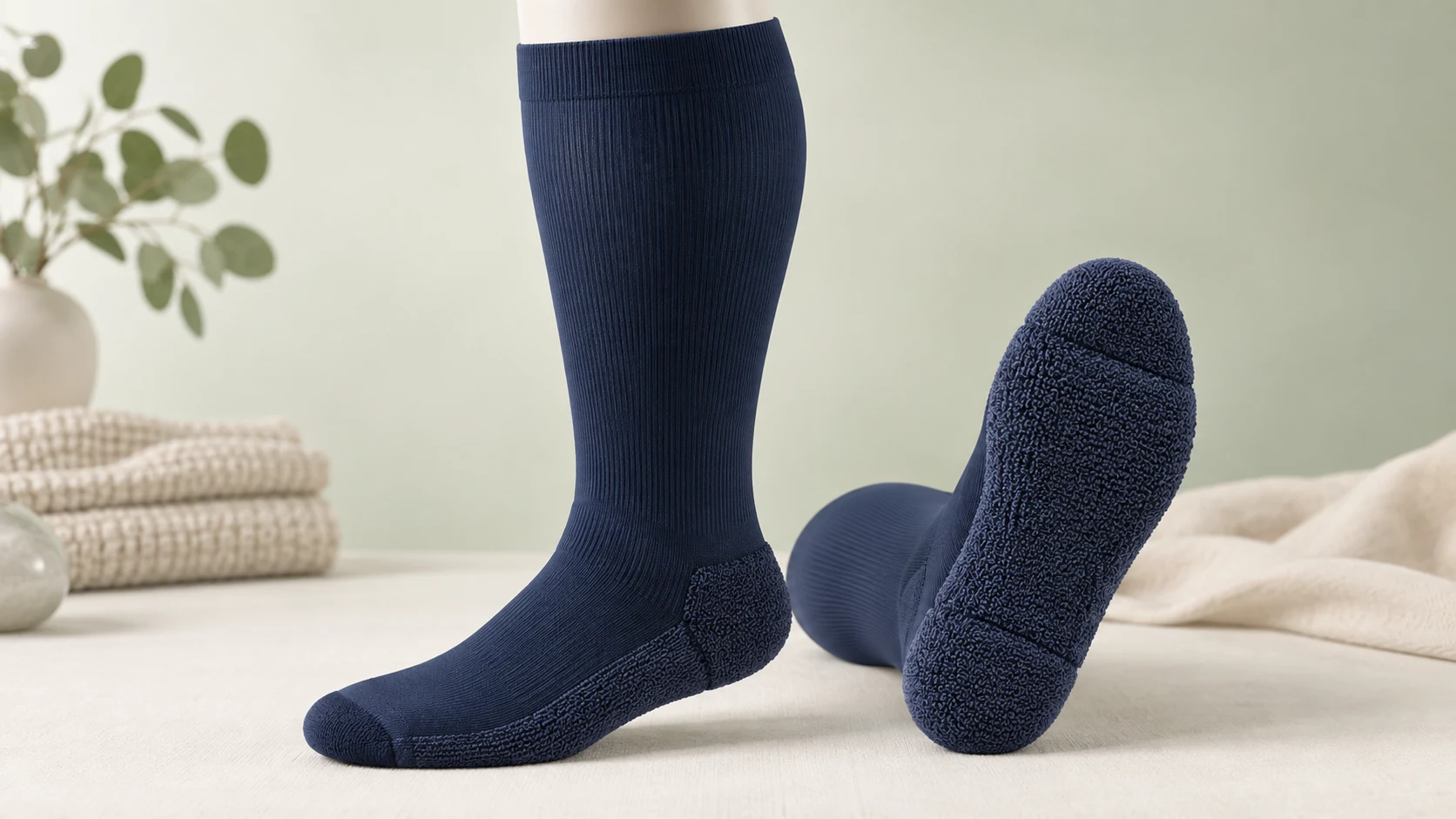
Concept visualization for product-development discussion. Confirm terry coverage, construction feasibility and the final approved sample before presenting this style as available.
A terry sole can make a compression sock feel very different even when the leg looks unchanged. Knitted loops add thickness and texture under the foot, which affects footwear volume, heat, drying, yarn use and inspection. For plus size compression socks, that footbed also has to coordinate with a broader foot, accurate heel placement and a wide-calf compression body.
This guide helps distributors, workwear buyers, private label brands and other B2B purchasers prepare a terry sole compression sock brief. It does not assume that one cushion structure suits every channel or that the construction automatically delivers a specific comfort, moisture or medical outcome. Confirm equipment, yarn, MOQ, sampling and testing with the supplier before launch.
What is a terry sole?
A terry sole uses loops knitted on the inside of the sock to create a thicker footbed. The loops may cover the full sole, only the heel and toe, or another mapped zone. “Terry sole,” “cushioned sole” and “plush footbed” are sometimes used loosely, so an RFQ should include a physical reference or clear inside-out photographs.
Specify whether cushioning covers the heel, arch, ball, toe and sidewall. A full-foot terry construction is different from a targeted cushion map, and a terry loop is different from simply adding a thicker smooth knit. The approved sample should show both the inside loop structure and the outside appearance.
Start with the target channel and footwear
The right cushion level depends on where the sock will be used. Workwear, nurse uniform, travel, outdoor and daily-wear programs may pair the sock with very different shoes. A dense footbed that feels substantial in a boot may occupy too much space in a close-fitting work shoe.
Include representative footwear in the wear trial. Check standing and walking, but also confirm that the sock can be put on and removed without the thicker footbed pulling the heel out of position. Document insole type and shoe volume so sample feedback can be interpreted consistently.
Coordinate terry thickness with plus size foot grading
Adding loops changes the internal volume of the sock. If the original foot pattern is retained without review, the finished sock may feel shorter or tighter around the forefoot. Buyers should recheck foot length, forefoot circumference, heel position and toe-box depth on the cushioned construction.
Calf and foot grades should not be treated as one number. A larger calf does not always require a longer foot, and customers in the same shoe size can have different ankle and calf measurements. Sample the edge sizes and use the ankle, calf and foot grading guide to structure the range.
- Finished foot length with terry loops relaxed.
- Forefoot circumference and toe-box depth.
- Heel pocket length, width and position.
- Cushion boundary at the arch and sides.
- Ankle, calf, cuff and leg-length dimensions.
Keep cushion zones and compression zones distinct
Terry loops describe the inside foot structure; they do not establish the graduated compression profile. The buyer still needs a separate compression specification, measurement method and acceptance range. If the cushion map changes yarn mass or stretch around the foot and ankle, test the finished style rather than relying on results from a smooth-sole version.
Define where the looped zone ends and the compression body begins. Abrupt changes in thickness or elasticity can affect fit near the arch, heel and ankle. Review the transition on every planned size and retain the approved zone map for production.
Choose yarn and loop density as a system
Loop height, density, yarn size and fiber blend work together. A soft bulky yarn may create a plush hand but occupy more shoe space. A lower loop can reduce thickness but may provide a different tactile result. Buyers should compare finished samples at the same size rather than evaluate loose yarn alone.
Consider abrasion, recovery, pilling, laundering and drying alongside initial softness. If the product will carry moisture-management, cooling, warmth or odor-control wording, define and verify those claims separately. A terry structure by itself does not prove them.
For additional material planning, see the compression sock materials guide.
Define cushion coverage in the tech pack
A zone drawing is more reliable than a sentence such as “add towel bottom.” Show the cushion boundary from top, bottom and side views. Mark whether the arch remains smooth, whether loops wrap around the heel and toe, and how the terry meets any reinforced areas.
- Full sole, heel-and-toe or custom cushion map.
- Target loop height, density or approved visual reference.
- Yarn composition and color for the looped zone.
- Heel, toe and arch reinforcement requirements.
- Foot and leg size table with finished tolerances.
- Compression level, test method and measurement points.
- Footwear type, care instructions and packaging format.
Ask whether the terry structure changes machine setup, yarn consumption, MOQ, sampling stages or production lead time. Confirm feasibility before using the feature in sales materials.
Sample approval checklist
Inspect samples from the inside and outside. The cushion zone should match the approved map without bare patches, pulled loops or unintended thickness at the transitions. Compare the pair for weight, shape and heel alignment.
- Confirm loop coverage under the heel, sole, ball and toe.
- Check for missing, flattened, uneven or pulled loops.
- Measure foot length, forefoot width, heel position and leg dimensions.
- Check the arch transition for bunching or a hard edge.
- Test donning and removal across representative foot and calf sizes.
- Wear-test in target footwear with the intended insole.
- Verify compression using the agreed method and test points.
- Repeat size, appearance and recovery checks after laundering.
Bulk quality control for terry soles
Bulk inspection should use an inside-out approved sample and zone map. Record defects such as missing loops, bare areas, excessive loop pulls, wrong coverage, inconsistent thickness, heel misalignment and cushion zones extending beyond the approved boundary.
Pair weight or product weight can be a useful consistency reference when agreed with the supplier, but it should not replace visual and dimensional inspection. Weight can vary for more than one reason. Combine it with foot measurements, loop coverage and compression checks.
Packaging and customer communication
Show the real inside sole in product photography so buyers and end customers understand where the cushioning is placed. If the construction adds noticeable thickness, sizing and footwear guidance should not suggest that it fits identically to a thin smooth-sole style without supporting trials.
Use factual wording such as “terry-loop cushioned footbed” and describe the approved coverage. Avoid automatic claims about blister prevention, circulation, pain relief, temperature or moisture unless supported by suitable evidence and reviewed for the destination market.
Questions to include in an RFQ
- Which terry coverage options can be produced with the required compression construction?
- Can you provide inside-out samples or references for loop height and density?
- How will added footbed volume be allowed for in each foot size?
- Does terry construction change MOQ, sample time, yarn use or price?
- How are pulled loops, bare zones and cushion boundaries inspected?
- Can the final cushioned style be tested to the buyer's compression specification?
Buyers can review the custom compression socks program, compare wide-calf sizing, or submit a cushion-zone brief through the quote and sample form.
FAQ
What is a terry sole in a compression sock?
It is an internal knitted-loop structure placed in selected footbed zones to create a thicker cushioned construction.
Does a terry sole make every shoe fit tighter?
It adds material volume, but the effect depends on loop density, yarn, foot grading and the shoe. Test the finished sock in representative footwear.
Does terry cushioning prove moisture or medical performance?
No. Cushion construction, moisture management and medical claims are separate matters and require their own evidence.
Which terry sole defects should bulk inspection cover?
Inspect uneven or missing loops, bare areas, pulled loops, incorrect zone boundaries, inconsistent thickness and heel misalignment.