
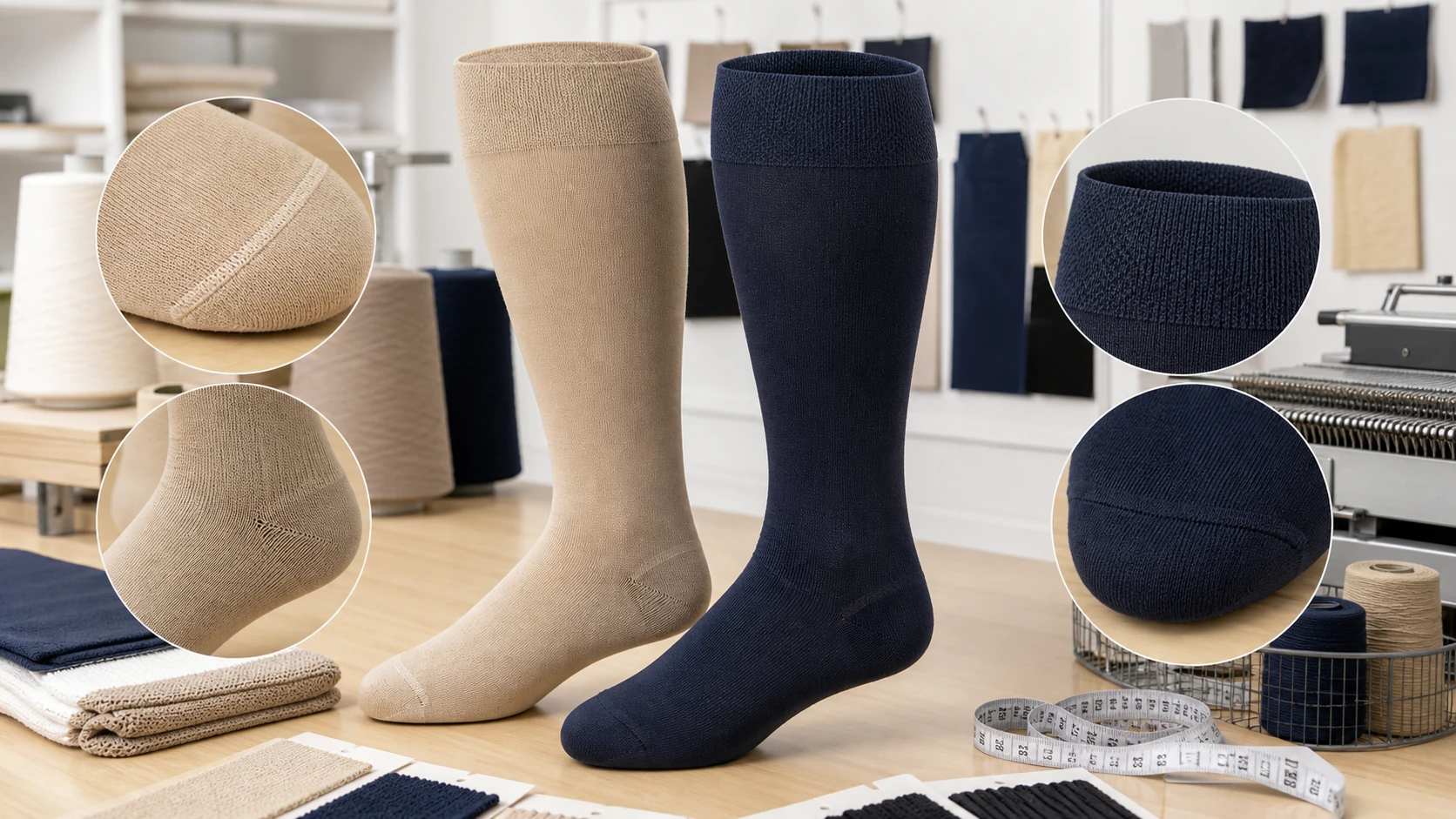
Customers often describe discomfort at the toe or top band without knowing which construction caused it. For wholesale buyers, the toe seam and cuff are therefore important sample-approval areas, not minor finishing details.
Both features need to work with the intended calf range, compression level, footwear and wearing time. A design that is acceptable in a standard sock may feel different when the fabric is stretched over a larger calf.
What buyers should define before sampling
A complete brief gives the factory a measurable target and reduces revisions. Confirm these points before treating a sample as ready for approval:
- Closed toe or open toe construction.
- Toe-seam type and seam allowance.
- Reinforcement at toe and heel.
- Top-band width and elastic distribution.
- Cuff stretch and recovery target.
- Anti-roll and skin-contact requirements.
Choose a toe construction for the use case
A smooth or linked toe can reduce prominent seam bulk inside footwear, while a standard closure may support a different price target. Open toe styles remove toe coverage but require a comfortable, stable opening.
Buyers should check the seam while the sock is worn with typical shoes. The position, thickness and finishing can matter more than the technical name alone.
Balance cuff hold and comfort
A wider cuff can distribute force over a larger area, but width alone does not guarantee comfort. Elastic strength, knit density, edge finishing and calf range all influence whether the sock stays up or rolls.
Wear-test the cuff at the top of each target size range. Check for folding during walking and for concentrated marks after extended wear.
Use construction details in product positioning
Online listings can show close-up images of the toe seam, cuff and fabric. Clear construction visuals help private label brands explain comfort features without relying on unsupported performance claims.
For wholesale presentations, provide a comparison sample when buyers are choosing between seam or cuff options. Physical differences are easier to understand than a specification name.
Sample approval checklist
Use the approved sample as a production reference, not only a sales photo. Record the results of the following checks and retain the final version:
- Wear the sample with the intended footwear.
- Feel the toe seam under natural foot movement.
- Check open toe edges for rubbing or movement.
- Wear-test cuff rolling and pressure at range boundaries.
- Inspect reinforcement after washing.
- Approve close-up construction references for production.
OEM and commercial planning
Construction choices should be written into the bill of materials and sample record. If a buyer creates good, better and best tiers, toe finishing and cuff design can be meaningful differentiators. However, every tier must still meet the basic fit and durability requirements.
Buyers can compare related styles in Our Products, review private label compression socks capability and share their target sizes, quantities and packaging through the contact form.
Common mistakes to avoid
- Approving a seam by appearance without wearing it in shoes.
- Assuming a wider cuff always prevents rolling.
- Changing elastic strength without new fit testing.
- Using close-up marketing claims that do not match bulk construction.
- Ignoring the largest calf size during cuff approval.
Final recommendation
Inspect toe and cuff details under real use conditions. These areas influence comfort, product reviews and perceived quality far more than their small size suggests.
Specifications and claims should be confirmed for the product, sales channel and destination market before ordering or publishing customer-facing materials.
FAQ
Is a seamless toe completely without a join?
Terminology varies. Buyers should inspect the actual closure and sample feel rather than relying only on the word seamless.
Does a wide cuff prevent roll-down?
It can help distribute pressure, but knit structure, elastic recovery, calf grading and leg shape also affect rolling.
When is an open toe style useful?
It can suit programs where toe freedom, footwear compatibility or customer preference is important, but the opening must be tested for comfort.
Should cuff construction change by size?
It may need adjustment across a broad plus size range to maintain hold and comfort, so edge sizes should be sampled.