
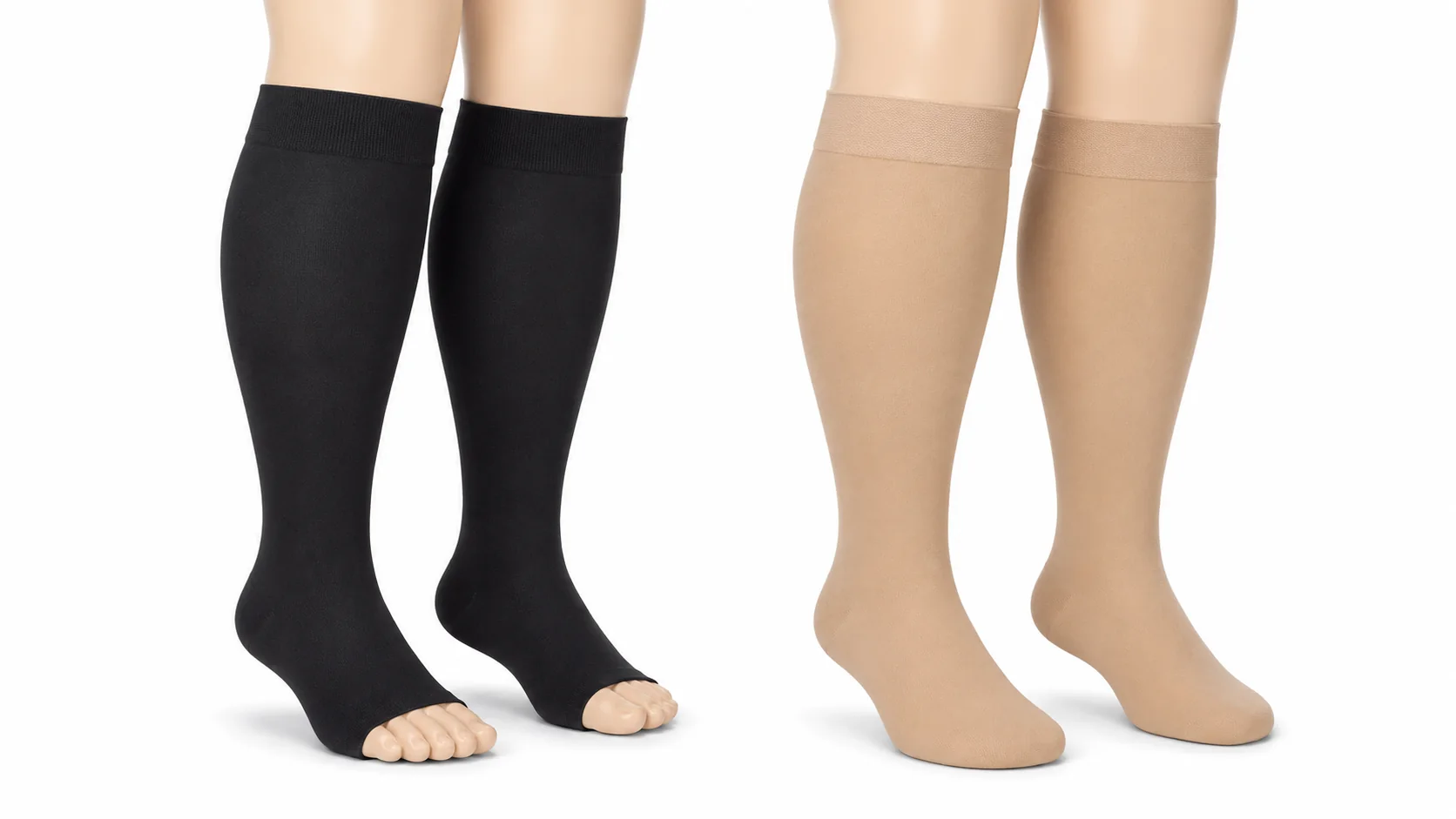
Why toe style matters in wholesale planning
For wholesale buyers, choosing between open toe and closed toe plus size compression socks is not only a style decision. Toe construction affects comfort, sizing flexibility, seasonal demand, product reviews and how easily customers understand the product online.
Plus size compression socks are designed for customers who need a wider calf fit, more stretch and a comfortable cuff. When buyers build a product line, open toe and closed toe styles can serve different customer needs. The best choice depends on the target market, sales channel and product positioning.
What are open toe plus size compression socks?
Open toe plus size compression socks leave the toes uncovered while still providing support through the foot, ankle and calf area. This design is often selected by customers who prefer more toe freedom, better breathability or less pressure around the toe area.
For B2B buyers, open toe styles can be useful because they fit a wider range of foot lengths. Since the toe area is open, there is usually less concern about toe seam pressure or exact foot length matching.
Open toe compression socks are commonly used for warm-weather assortments, comfort-focused listings, medical supply channels, recovery product ranges and customers who dislike tight toe areas in regular socks.
What are closed toe plus size compression socks?
Closed toe plus size compression socks look closer to traditional socks. The toe area is fully covered, which creates a familiar wearing experience and better warmth. This style is often easier for retail customers to understand because it looks like an everyday compression sock.
Closed toe styles are suitable for daily wear, work shoes, travel, nursing uniforms and cooler seasons. They are also strong options for multipacks because black, beige, white and navy can cover most basic retail needs.
Key differences for wholesale buyers
The main difference is how each style fits into the buyer's target market. Open toe socks offer more breathability and foot length flexibility. Closed toe socks offer a more traditional full-foot feel and broader daily-wear appeal.
For plus size customers, calf fit remains the most important factor. Whether the sock is open toe or closed toe, the product should have enough calf stretch, a comfortable top band, stable compression and clear sizing guidance for large calves.
Which style is better for private label brands?
For private label brands, closed toe socks are often a strong basic product. They are easy to photograph, easy to explain and suitable for e-commerce listings, retail multipacks and workwear customers.
Open toe socks can work well as a specialized comfort option. They are useful for buyers who want to offer more choice, reduce toe pressure complaints and serve customers looking for flexible sizing.
A balanced private label product line may include closed toe socks as the main daily-wear product and open toe socks as a comfort or warm-weather option. Buyers can then use shared packaging design, similar color planning and the same wide calf size chart to keep the line consistent.
Sizing considerations for plus size compression socks
Wholesale buyers should not rely only on shoe size. Calf circumference is usually more important for plus size compression socks. A clear size chart should include calf range, sock length and foot length guidance.
Open toe styles may offer more flexibility in foot length, while closed toe styles need more careful checking because the toe seam and foot length directly affect comfort.
Before bulk production, buyers should request samples and check cuff stretch, ankle fit, foot length, toe opening finish and whether the socks are easy enough to put on for the target customer group.
Seasonal and retail channel differences
Closed toe plus size compression socks usually have broader year-round retail potential. They work well for nurses, office workers, travelers, warehouse staff and daily support customers.
Open toe plus size compression socks may perform better as a warm-weather product or a comfort-focused add-on. They can also be positioned for customers who wear sandals at home or prefer less toe coverage.
For online sellers, the product title and images should make the difference clear. Buyers should show the toe area directly in product photos and avoid using only folded sock images, because customers need to understand the construction before purchase.
OEM product planning checklist
When sourcing open toe or closed toe plus size compression socks, buyers should confirm MOQ, available compression levels, size range, color options, yarn composition, logo service, packaging formats, sample lead time and bulk production schedule.
For closed toe socks, check toe seam smoothness and foot length accuracy. For open toe socks, check the edge finish around the toe opening to make sure it feels comfortable and does not roll or rub.
Buyers planning OEM or private label projects can start from plus size open toe compression socks, compare with plus size compression socks, and then define packaging through a private label compression socks program.
Final recommendation
For wholesale buyers, closed toe plus size compression socks are a strong choice for daily wear, travel, workwear and multipack sales. Open toe plus size compression socks are a useful option for comfort-focused customers, warm-weather markets and buyers who want more flexible foot fitting.
The best product line often includes both styles. By offering open toe and closed toe options, B2B buyers can cover more customer needs and build a more complete plus size compression socks collection.
FAQ
Q: Should wholesale buyers choose open toe or closed toe first?
A: Closed toe is usually the stronger basic style for daily retail. Open toe is a useful second style for comfort, warm-weather and flexible-fit customer groups.
Q: Can open toe plus size compression socks be private label?
A: Yes. OEM options can include custom color, logo, size sticker, polybag, pouch, retail box, barcode label and carton mark.
Q: What should buyers check before bulk production?
A: Check calf range, cuff comfort, compression feel, foot length, toe construction, packaging proof and sample wearing feedback before confirming a bulk order.