
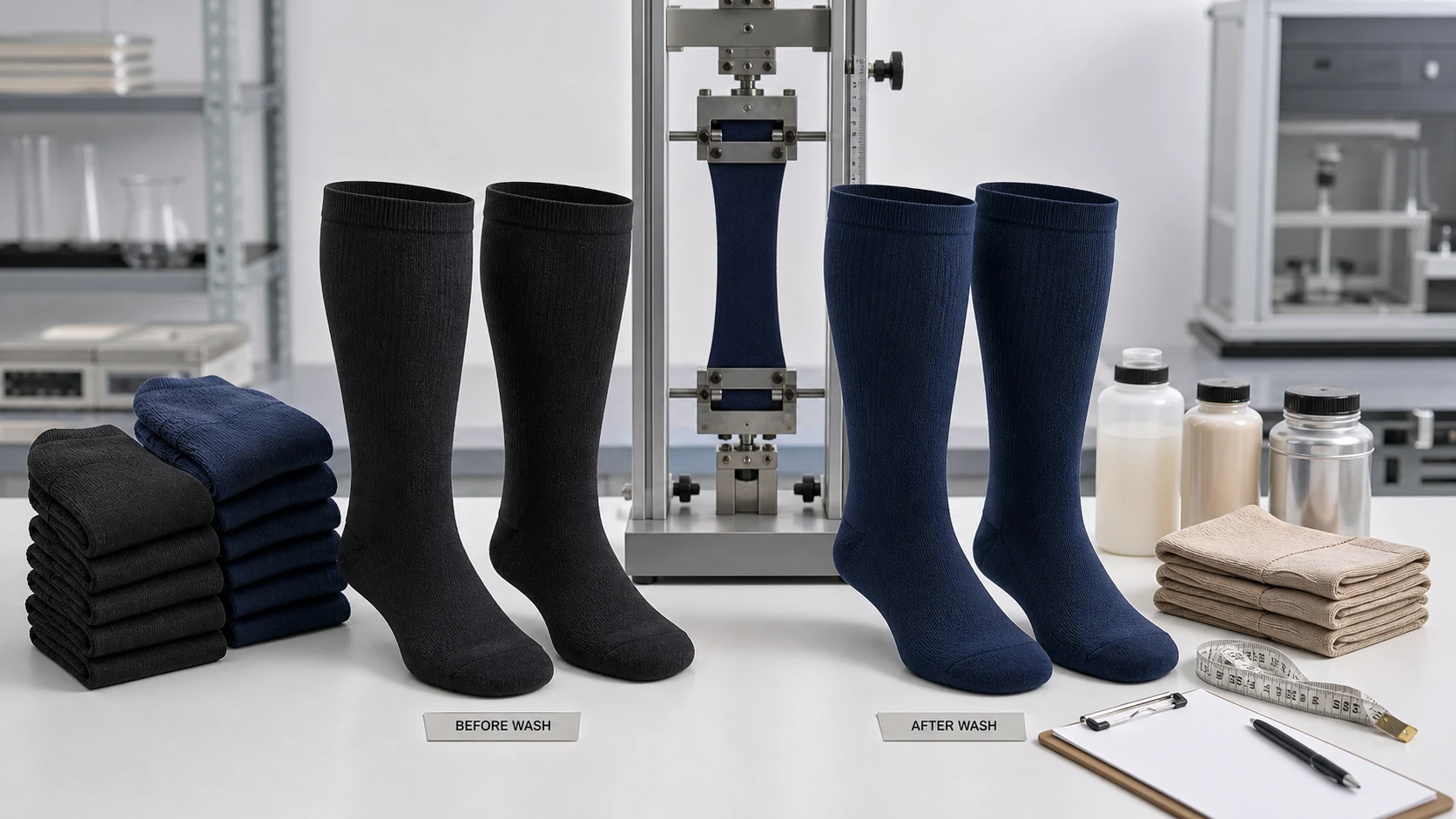
Wide calf compression socks are repeatedly stretched during donning, wear and removal. Washing adds heat, water, detergent and mechanical action, so a sample that looks correct when new may change after a few care cycles.
Recovery testing helps buyers evaluate whether the cuff, calf and ankle return close to their intended dimensions. It also checks whether care instructions are realistic for the chosen yarn and construction.
What buyers should define before sampling
A complete brief gives the factory a measurable target and reduces revisions. Confirm these points before treating a sample as ready for approval:
- Pre-wash measurements at defined points.
- Care method, temperature, detergent and drying method.
- Number of wash cycles.
- Post-wash conditioning time before measurement.
- Acceptable dimensional change and recovery.
- Visual standards for color, pilling and seam condition.
Establish a controlled test method
Mark the same measurement locations used in production QC and record them before washing. Follow one care procedure, then allow samples to dry and rest before measuring again.
Testing only one sock is risky. Use representative samples from relevant sizes and colors, because yarn tension and dyeing can influence the result.
Evaluate stretch and recovery by zone
The cuff, calf, ankle and foot experience different stress. A top band may grow while the calf fabric remains stable, or the ankle may lose recovery even though overall length looks unchanged.
Inspect each zone separately and compare it with the approved fit. Recovery should be judged against agreed tolerances, not a subjective impression.
Connect test results to care instructions
If a product performs well only under gentle washing and air drying, the label should say so clearly. Care instructions that customers are unlikely to follow can lead to complaints even when the laboratory sample passed.
Buyers should also decide whether shrinkage or relaxation changes the compression feel. Significant changes may require a material or construction adjustment.
Sample approval checklist
Use the approved sample as a production reference, not only a sales photo. Record the results of the following checks and retain the final version:
- Measure cuff, calf, ankle, foot and length before washing.
- Test multiple sizes and colors where possible.
- Photograph surface appearance under consistent light.
- Check seam integrity and elastic exposure.
- Repeat stretching after the final wash cycle.
- Confirm that care artwork matches the tested method.
OEM and commercial planning
Include the care test in sample approval and repeat it periodically for bulk production, especially after a yarn supplier or dye lot changes. Retailers can use validated care instructions to reduce misuse and support product-life expectations without making unrealistic durability promises.
Buyers can compare related styles in Our Products, review private label compression socks capability and share their target sizes, quantities and packaging through the contact form.
Common mistakes to avoid
- Measuring immediately after washing without conditioning.
- Testing overall length but not circumference recovery.
- Using a different wash method from the care label.
- Approving one color and assuming all colors behave the same.
- Ignoring pilling, color change or seam damage.
Final recommendation
A simple repeatable wash and recovery test is more useful than an informal stretch check. It connects product engineering, care labeling and customer experience.
Specifications and claims should be confirmed for the product, sales channel and destination market before ordering or publishing customer-facing materials.
FAQ
How many wash cycles should be tested?
The number depends on the product brief, but buyers should agree a meaningful cycle count before sample approval.
Why wait before post-wash measurement?
Fibers and elastic can change immediately after washing. A consistent conditioning period improves comparison.
Can dark and light colors behave differently?
Yes. Different dyeing and finishing processes can affect hand feel and dimensional stability, so representative colors should be checked.
What does poor recovery look like?
The cuff or calf remains enlarged, the ankle becomes loose, length changes excessively or the sock no longer matches the approved fit.