
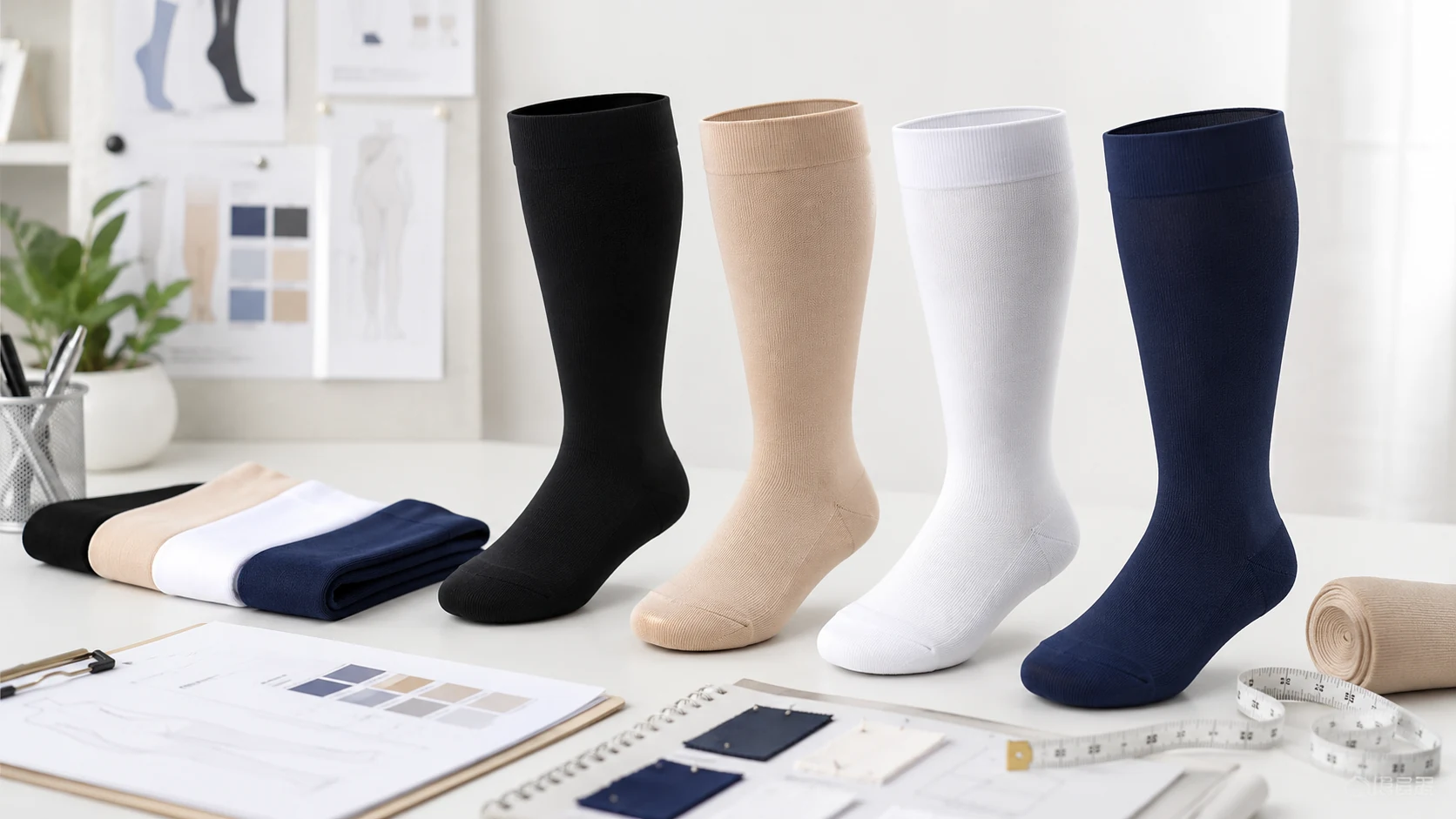
What are wide calf compression socks?
Wide calf compression socks are knee-high or similar compression products designed with more room through the calf than a standard construction. They are bought by customers whose feet may fit regular sizing but whose lower-leg circumference makes standard cuffs uncomfortable. Plus size users are an important market, but athletes, nurses, travelers and standing workers can also need a wider calf.
For wholesale buyers, the category should be defined by measurements rather than marketing language. A clear product includes foot or shoe size, ankle circumference, maximum calf circumference and leg length, supported by a tested compression specification.
1. Define the target customer and sales channel
Begin with who will wear the sock and where it will be sold. Pharmacy buyers may need neutral colors, simple measurement graphics and restrained support claims. Nurse uniform retailers may prioritize durable yarn, patterns and long-shift comfort. Travel sellers may need lightweight construction and multipacks, while e-commerce brands should focus strongly on fit guidance and return reduction.
Use customer reviews, return reasons and service questions to identify unmet needs. This evidence is more useful than copying another brand's XL label because body proportions and channel expectations vary.
2. Start with calf circumference
Before choosing patterns or packaging, define the calf range. A practical planning reference may be regular calf around 30-40 cm, wide calf around 40-55 cm and extra wide around 55-70 cm, but these are not universal standards. The final chart must match the target market, compression construction and wear testing.
State where the calf is measured and show centimeters and inches when selling internationally. Include ankle circumference because adding calf room without controlling the ankle can create wrinkles. The measurement guide provides a repeatable method.
3. Decide whether you need wide calf or full plus size
A wide calf extension can work when standard foot sizing is successful but the upper leg is too narrow. A full plus size program is more appropriate when customers also require larger feet, ankles or leg lengths. Some brands need both categories, with separate charts to prevent overlap and confusion.
Do not force one highly elastic size to cover an extreme circumference range. That can make the smaller end loose and the larger end difficult to put on. Review our wide calf vs plus size guide before defining product names.
4. Choose the pressure level and claims carefully
Light daily support, travel positioning and firmer compression programs serve different requirements. Specify the intended pressure range, how it will be tested and which sizes will be checked. Larger garment dimensions can influence performance, so testing only a standard size is not enough for an extended range.
Medical claims and pressure labeling depend on the destination market. Buyers should verify local requirements before printing boxes or online content. Use language supported by the finished product and documentation.
5. Check materials and comfort details
Nylon-spandex constructions are common for durability and controlled recovery. Bamboo blends may support a softer comfort story, while lighter wicking yarns can suit warm climates and travel. Material choice must be reviewed together with thickness, opacity, pilling, drying and wash recovery.
Top-band structure, toe seam, heel placement and leg length can matter as much as the fiber blend. A wide cuff should hold the sock without cutting in, and stretched patterns should remain readable on the largest target calf. See the material guide for more detail.
6. Select styles for a focused first assortment
Core black, navy, gray and skin-tone styles can validate sizing with lower assortment risk. Nurse and online gift channels may then add stripes, dots, medical patterns or seasonal colors. Open toe, zipper and bamboo options can extend the range once the central fit is stable.
Keep size logic consistent across colors and packs. Customers who reorder a patterned style should not encounter a different calf fit from the solid version unless the construction difference is stated clearly.
7. Plan private label packaging around selection
The front of the package should identify the product type and size clearly. The back or side can show the measurement chart, compression information, fiber content, care, country of origin and required business details. Online listings should repeat the same chart and measurement method.
Confirm package dimensions after the sock fold and pack quantity are approved. Wide calf socks may create a thicker or larger pack than regular styles. Custom pouches, retail boxes, barcode labels and marketplace labels can each have separate minimums and lead times.
8. Approve samples across the range
Test at least the lower and upper ends of each proposed calf range. Review donning, cuff comfort, ankle wrinkles, heel position, leg length, slipping and roll-down while the wearer stands, sits and walks. Repeat the evaluation after washing.
Use a written specification and photograph the approved result. A sample approval checklist helps buyers compare revisions without relying on memory.
9. Confirm bulk inspection and repeat-order control
Bulk quality control should cover measurements, appearance, toe closure, cuff, stretch recovery, color, pattern, compression checks where required, pair matching and packaging assortment. Retain an approval sample and production records for comparison with repeat orders.
Ask how different sizes and batches are identified. Clear traceability reduces the risk of mixed size labels or cartons and makes corrective action more focused if a problem occurs.
10. Compare total program cost
Unit price is only one part of the buying decision. Include sampling, revisions, custom yarn or color minimums, packaging setup, inspection, freight and return risk. A slightly higher-cost construction with a clearer size chart and better recovery may create a lower total cost than a cheap standard sock that generates fit complaints.
OEM inquiry checklist
- Target market, wearer and sales channel.
- Foot, ankle, calf and leg-length ranges.
- Compression level and required test method.
- Material, toe style, cuff and color direction.
- Logo, packaging, barcode and carton requirements.
- Quantity by size and color, sample deadline and delivery date.
For product development, start with wide calf compression socks and send a complete brief through the contact request.
FAQ
What calf size is considered wide calf?
There is no global standard. For this website, wide calf planning commonly covers approximately 40-55 cm, while extra wide projects may cover approximately 55-70 cm depending on the complete size and compression specification.
Can wide calf compression socks be private label?
Yes. OEM options can include custom sizing, colors, patterns, knitted or package logos, hang tags, retail boxes, pouches, barcode stickers and carton marks.
How many sizes should a first range include?
Use the smallest number that still covers meaningful customer groups without excessive stretch. The right number depends on foot, ankle, calf and leg-length data, not a fixed industry rule.