
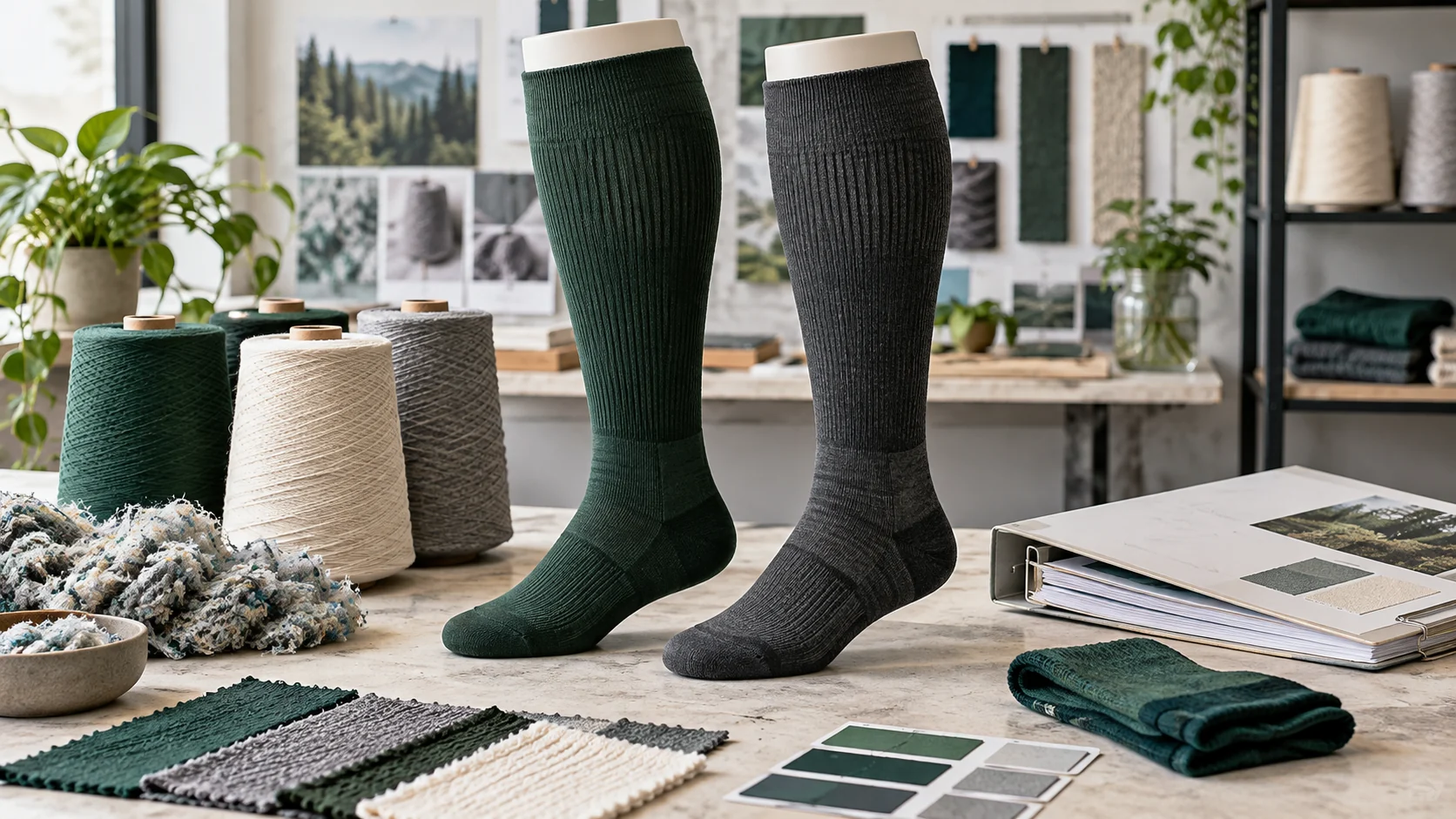
Concept visualization for product-development discussion. Confirm yarn availability, recycled-content documentation, final composition, compression and manufacturing feasibility before presenting this style as available or certified.
Recycled-content yarn can give a private label compression sock range a clearer material story, but the claim must begin with evidence rather than packaging artwork. For a plus size program, the buyer also has to protect stretch, recovery, fit and pressure performance across a wider calf range. Changing yarn without revalidating the finished sock can create a product that looks familiar but behaves differently.
This guide helps wholesalers, distributors and brand owners prepare a practical recycled-yarn development brief. It separates measurable product facts from broad environmental language and keeps sampling, documentation and bulk control connected.
Define the recycled-content target precisely
Start by naming the fiber and the part of the sock where recycled content is proposed. “Made with recycled materials” does not explain whether the claim refers to recycled polyester, recycled nylon, packaging, or a limited decorative yarn. Ask for the target percentage in the finished product and identify components that may remain virgin material.
Compression constructions commonly combine body yarns, covering yarns, elastane or other elastic components, cuff yarns and reinforcement. A development brief should list these separately. The final label must reflect the verified composition, not the composition of one yarn cone considered in isolation.
Build a document trail before approving a claim
Documentation needs vary by market, buyer policy and wording. A useful file may include supplier declarations, fiber specifications, purchase records, lot references and any applicable chain-of-custody or transaction documents. Buyers should confirm whether a claimed standard covers the yarn supplier, the sock manufacturer, the finished product or only one stage.
Do not place certification marks on packaging until the mark owner’s rules, scope and approval process have been checked. A certificate mentioned in a sales conversation does not automatically authorize a logo or guarantee that every production lot is covered.
Compare the final blend, not just the sustainability story
Recycled yarn may differ from a current yarn in count, texture, shade, strength, elongation or supply consistency. These differences can affect knitting settings and the finished hand feel. Ask the supplier to state the complete proposed blend and create the sample using the same material direction intended for bulk.
Review the compression sock materials guide when comparing nylon, polyester, elastic fibers and comfort requirements. A recycled-content decision should still meet the product’s fit, care and channel needs.
Revalidate foot, ankle and wide-calf grading
Do not assume that a size chart approved with another yarn will transfer unchanged. Measure the final sample at the foot, ankle, calf, cuff opening and finished height. Fit-test sizes near the lower and upper limits of the planned range, including users with different foot-to-calf proportions.
Look for excessive transparency on the widest calf, an over-tight ankle transition, cuff distortion and heel misalignment. Record the sample condition and measurement method so the results can be compared after laundering and during bulk inspection.
Approve color with realistic lot expectations
Recycled fiber feedstock and yarn processing may influence color availability or lot consistency. The buyer should approve color on the proposed final blend, not on a standard swatch from another material. Deep forest green, charcoal, navy and neutral tones can support a responsible-material collection, but every shade still needs its own approval.
Define the light source, physical standard and acceptable shade range. If a program combines several sizes and colors, keep sample identification clear so the approved shade is not separated from its yarn and construction record.
Test performance after the material change
A sustainability claim cannot replace product testing. The finished construction should be evaluated for dimensions, pressure using the agreed method, stretch recovery, abrasion, pilling, colorfastness and wash stability. Testing should represent the final size, yarn combination and finishing process.
- Record the full composition and supplier lot references.
- Measure relaxed dimensions before and after agreed wash cycles.
- Check stretch and recovery at the foot, ankle, calf and cuff.
- Inspect surface pilling, abrasion and yarn exposure.
- Evaluate shade change and color transfer where relevant.
- Confirm care instructions against the tested construction.
- Retain a sealed approval sample for bulk comparison.
The wash and stretch-recovery guide provides a related recording framework.
Keep packaging language narrow and verifiable
Useful packaging can state verified fiber composition, the documented recycled-content percentage, size information and care instructions. Avoid broad phrases such as “zero impact,” “fully sustainable” or “planet safe” unless the buyer has robust evidence and legal review for the target market.
Separate product claims from packaging claims. A recycled paper box does not establish that the sock contains recycled fiber, and recycled yarn does not establish that every packaging component is recycled. Review the private label packaging guide when preparing artwork.
Control traceability from sample to bulk order
The purchase specification should connect the approved yarn, color, size chart, construction and documentation set. During bulk inspection, check labels and cartons against the correct lot information as well as physical dimensions and appearance. Any material substitution should trigger buyer review before production continues.
Use the bulk quality-control guide to structure inspection points. For a new program, submit the target fiber, claim wording, size range and market through the quote form or review custom compression sock development.
Prepare a complete recycled-yarn RFQ
A useful RFQ should state the target recycled fiber, preferred percentage, full size range, compression target, colors, estimated quantity, packaging market and proposed claim wording. Attach any buyer documentation policy instead of waiting until artwork approval. Ask the supplier to identify which requirements are confirmed, which need sampling and which depend on an external yarn source or document review.
Keep alternatives visible in the comparison. One proposal may offer a higher recycled-content percentage, while another may provide better recovery, color consistency or documentation for the target channel. The final decision should be based on the approved product and evidence package together, not on a single headline percentage.
FAQ
Can every yarn in a compression sock be recycled content?
Not necessarily. Elastic, reinforcement or supporting components may use different materials. Verify the composition of the finished product.
What evidence should support a recycled-content claim?
Depending on the claim and market, request composition records, supplier declarations, purchase documents and applicable chain-of-custody records.
Does recycled yarn change wide-calf sizing?
It can change hand feel, stretch or recovery. Sample and measure the final blend across the planned size range.
Can buyers print a certification logo on the package?
Only when the certification owner’s rules, scope and documents authorize that use.