
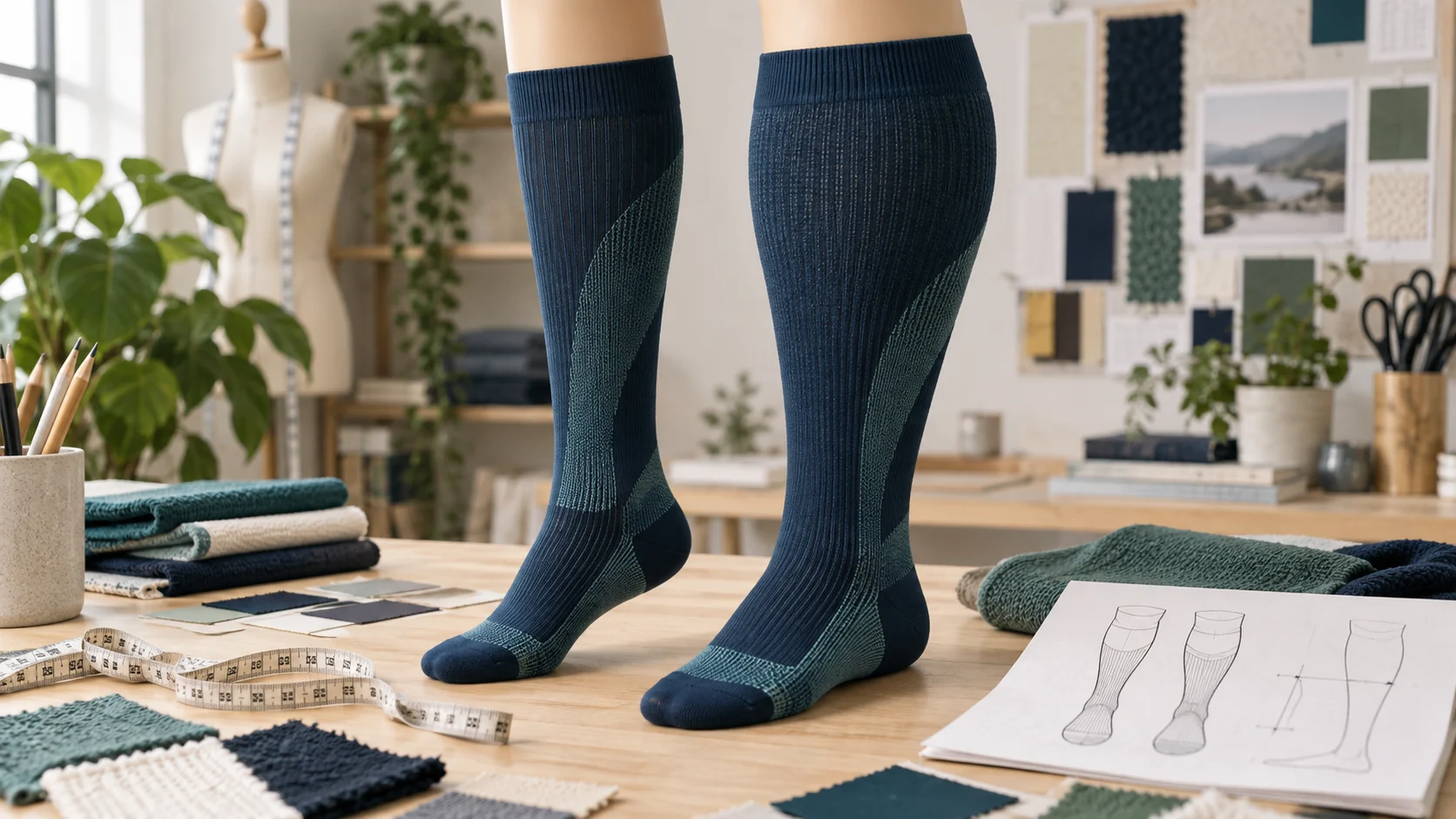
Concept visualization for product-development discussion. Final proportions, compression and construction must be confirmed through approved physical samples.
Repeated customer discussions show a sizing gap that a simple “wide calf” label does not solve: the wearer may have a small foot or narrow ankle and still need substantially more calf room. If every measurement increases together, the calf may fit while the foot wrinkles, the heel shifts or the ankle feels loose.
For wholesalers and private label brands, the answer is a combination-based size system. Foot, ankle, calf and leg length should be graded as connected measurements, but not forced into one fixed proportion.
Why standard proportional grading misses this customer
Many conventional size runs begin with shoe size and enlarge the full sock by a standard percentage. That approach is efficient for average proportions, but it can create a poor match at the edges. A size-six foot does not guarantee a small calf, and an eighteen-inch calf does not guarantee a long foot.
The same mismatch appears with narrow ankles and wide calves. If a factory widens the entire leg tube, the ankle may lose contact and fabric can collect above the heel. If it preserves a tight ankle without redesigning the transition, the sock may become difficult to put on. Both zones have to be developed together.
Measure four dimensions before naming sizes
Start with measurement data, then create consumer-facing labels. The development sheet should include at least:
- Foot length or the market-specific shoe-size range.
- Ankle circumference at the specified measuring point.
- Calf circumference at the widest point.
- Heel-to-knee length to define the finished sock height.
Forefoot width, instep circumference and heel diagonal are also useful when the intended range includes wider feet or when donning is a known concern. The calf measurement guide can support retail instructions, but a factory brief should retain the complete measurement table.
Build a matrix instead of one oversized XL
A practical range may pair more than one foot grade with the same calf grade. For example, “short foot / wide calf” and “regular foot / wide calf” can share a target calf range while using different foot length and heel placement. This is usually clearer than asking one XL or 3XL to cover every combination.
Do not publish example measurements until the finished samples have been tested. The number of combinations should reflect real demand, production feasibility and inventory capacity. A focused matrix that solves the most common mismatches is easier to stock than a large range with unclear boundaries.
Add petite and regular leg lengths where demand supports them
Shorter wearers may find that a standard knee-high sock crowds the crease below the knee or creates extra fabric in the leg. Calf circumference alone cannot solve that problem. A petite length should adjust the heel-to-cuff distance while preserving the intended foot, ankle and calf relationship.
During trials, confirm that the heel pocket stays aligned and that the cuff finishes below the knee without folding. Test seated and standing positions. A shorter sock should not be created by simply removing rows if that changes the planned pressure transition.
Control the ankle-to-calf transition
The transition zone is where a narrow ankle and wide calf pattern can succeed or fail. Review stitch density, circumference changes and yarn recovery along the lower leg. A sudden increase may create a visible step or uneven stretch; a transition that is too gradual may not provide enough calf capacity.
Ask the supplier to record relaxed dimensions at defined points rather than measuring only the cuff. For a broader method, see the ankle, calf and foot grading guide.
Test every size boundary, not only the middle
A middle-range fitting can hide the exact problems that cause returns. Recruit wearers near the smallest foot with the largest intended calf, the largest foot with the smallest calf, and the upper and lower ankle limits. Record donning, heel position, ankle wrinkles, cuff comfort and sock height.
- Check the foot for extra length, bunching and toe pressure.
- Confirm the heel pocket remains centered during movement.
- Look for loose fabric or sharp tension changes at the ankle.
- Evaluate the cuff at both calf limits over an extended wear period.
- Measure again after the agreed washing and drying cycles.
Compression claims require appropriate testing on the final construction. A good visual fit does not by itself verify a stated pressure range.
Turn the factory matrix into a clear retail chart
The consumer chart should lead with the measurements that actually determine fit. Show foot or shoe size, ankle range, calf range and leg length in one place. Explain what to do when a shopper falls between two combinations instead of defaulting to “size up.”
Product photography and diagrams should show where to measure. Use consistent units for the target market, include both centimeters and inches when useful, and avoid unsupported body-weight shortcuts. The size-chart return-reduction guide covers the commercial side of this process.
OEM brief and approval checklist
- Define the measurement source and target customer group.
- List every foot, ankle, calf and length combination.
- Set relaxed measurement methods and tolerances.
- Specify yarn, compression range and pressure-test method.
- Fit test the crossover and boundary combinations.
- Approve packaging instructions and the online size chart together.
- Retain sealed samples for each approved size before bulk production.
Buyers can review our wide-calf compression sock program, compare custom sizing options, or send a combination-size brief through the quote and sample form.
FAQ
Why do wide-calf compression socks sometimes feel loose at the foot?
The pattern may enlarge foot, ankle and calf together even though the wearer needs a small foot with a wider calf. Independent grading creates a more appropriate combination.
Is shoe size enough to select wide-calf compression socks?
No. Combine foot length with ankle circumference, calf circumference and heel-to-knee length.
Do petite wearers need a separate sock length?
Often they do. A measured petite grade can reduce excess fabric below the knee, but it should be validated in physical samples.
How should buyers validate a combination size chart?
Test users near every boundary, check finished dimensions and fit, then repeat the relevant checks after laundering before bulk approval.