
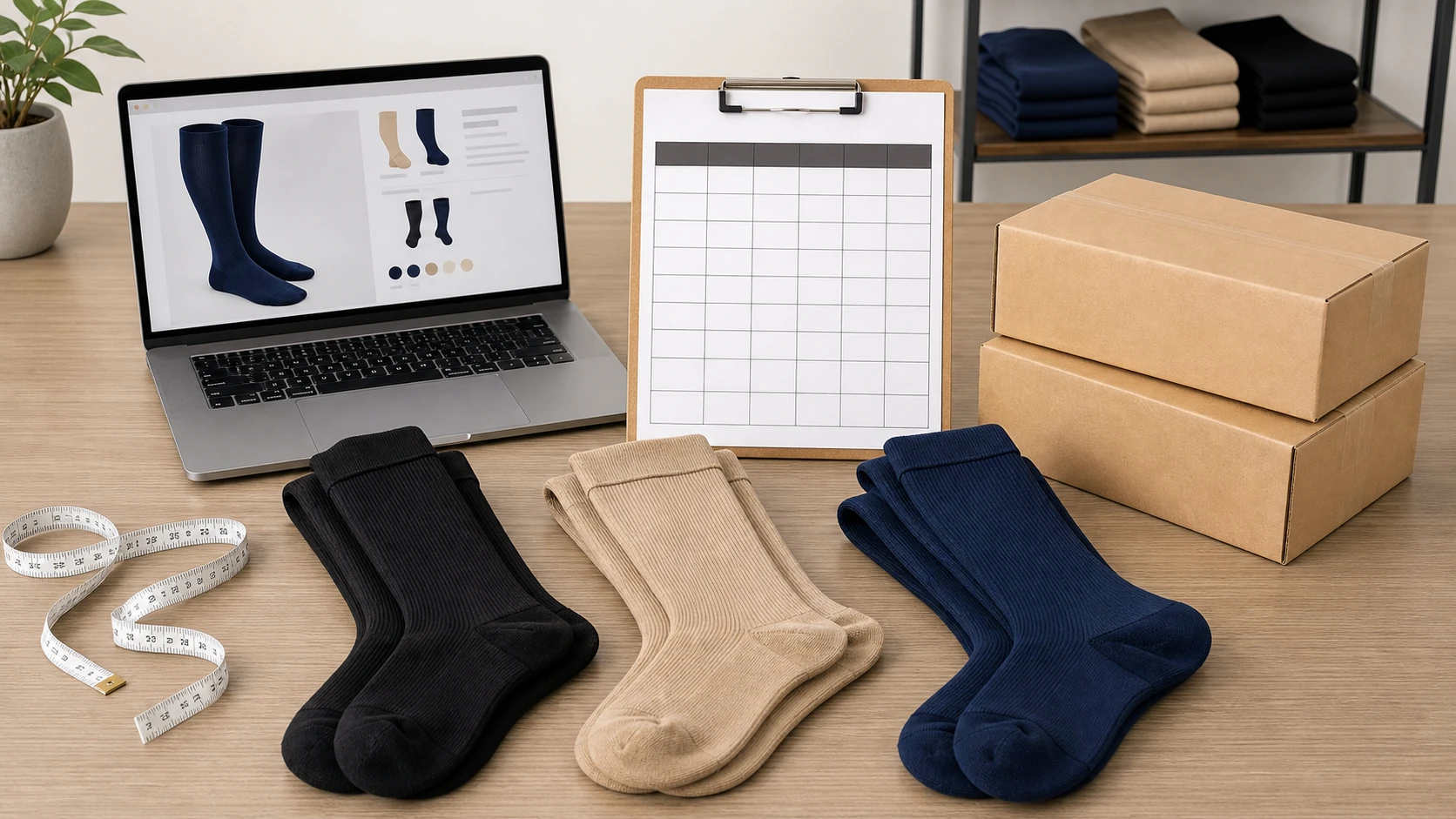
Returns in the plus size compression socks category often begin before the customer opens the package. If the listing shows only a shoe-size conversion or an unclear 2XL-7XL scale, customers may choose a sock that fits the foot but not the calf.
A better chart reduces uncertainty by showing the measurements that actually determine fit. It also gives customer service a consistent answer and provides the factory with a clear specification for repeat production.
What buyers should define before sampling
A complete brief gives the factory a measurable target and reduces revisions. Confirm these points before treating a sample as ready for approval:
- Ankle circumference for every size.
- Calf circumference for every size.
- Foot length and regional shoe-size equivalents.
- Leg length where short or tall options matter.
- A visible measuring diagram.
- A rule for customers whose measurements cross two sizes.
Put calf circumference before generic labels
Customers searching for plus size compression socks are usually trying to solve a calf-fit problem. Make calf circumference a primary column and explain that it should be measured at the widest point.
Size names can remain on the chart, but they should function as labels for tested body ranges. They should not be the only information used to choose a product.
Use the same chart everywhere
The product page, marketplace image, retail box, instruction card and support script should use the same measurements. A mismatch of even a few centimeters can create doubt and increase returns.
Maintain one approved source file for each style. When the factory updates a pattern or range, update all customer-facing materials before the new batch ships.
Learn from return reasons
Track whether returns are caused by a tight cuff, loose ankle, short foot, excessive length or difficult donning. These reasons point to different product and communication problems.
If customers repeatedly select the wrong size, improve the decision rule and imagery. If correctly measured customers still report poor fit, the product grading or manufacturing consistency needs review.
Sample approval checklist
Use the approved sample as a production reference, not only a sales photo. Record the results of the following checks and retain the final version:
- Compare every published range with the approved production specification.
- Test size-boundary customers before launch.
- Check that diagrams show the correct measuring location.
- Review chart readability on a mobile screen.
- Confirm units and regional shoe-size conversions.
- Ask customer service to test the selection instructions.
OEM and commercial planning
A clear chart can support conversion because it answers a high-intent question at the point of purchase. Include the chart near the product options, repeat the key calf range in images and provide an easy route to ask for help. For wholesale accounts, supply editable chart assets so retailers do not recreate the ranges incorrectly.
Buyers can compare related styles in Our Products, review private label compression socks capability and share their target sizes, quantities and packaging through the contact form.
Common mistakes to avoid
- Showing only shoe size.
- Using a generic chart across different constructions.
- Hiding calf measurements in small text.
- Publishing factory garment measurements as body measurements.
- Ignoring mobile readability.
Final recommendation
Use a tested body-measurement chart as part of the product itself. Better sizing information cannot fix a poor pattern, but it can prevent many avoidable selection errors and reveal where the product needs improvement.
Specifications and claims should be confirmed for the product, sales channel and destination market before ordering or publishing customer-facing materials.
FAQ
Which measurement is most important for wide calf socks?
Calf circumference is usually the first measurement, followed by ankle circumference and foot size.
Can one size chart be used for every style?
Not always. Different cuffs, yarns, compression targets and constructions may require different tested ranges.
Should charts show garment measurements?
Customer-facing charts should primarily show body measurements. Finished-sock measurements belong in the factory specification and quality-control documents.
How can a chart help customer service?
It gives support staff a consistent decision process and reduces subjective recommendations based only on a size label.