
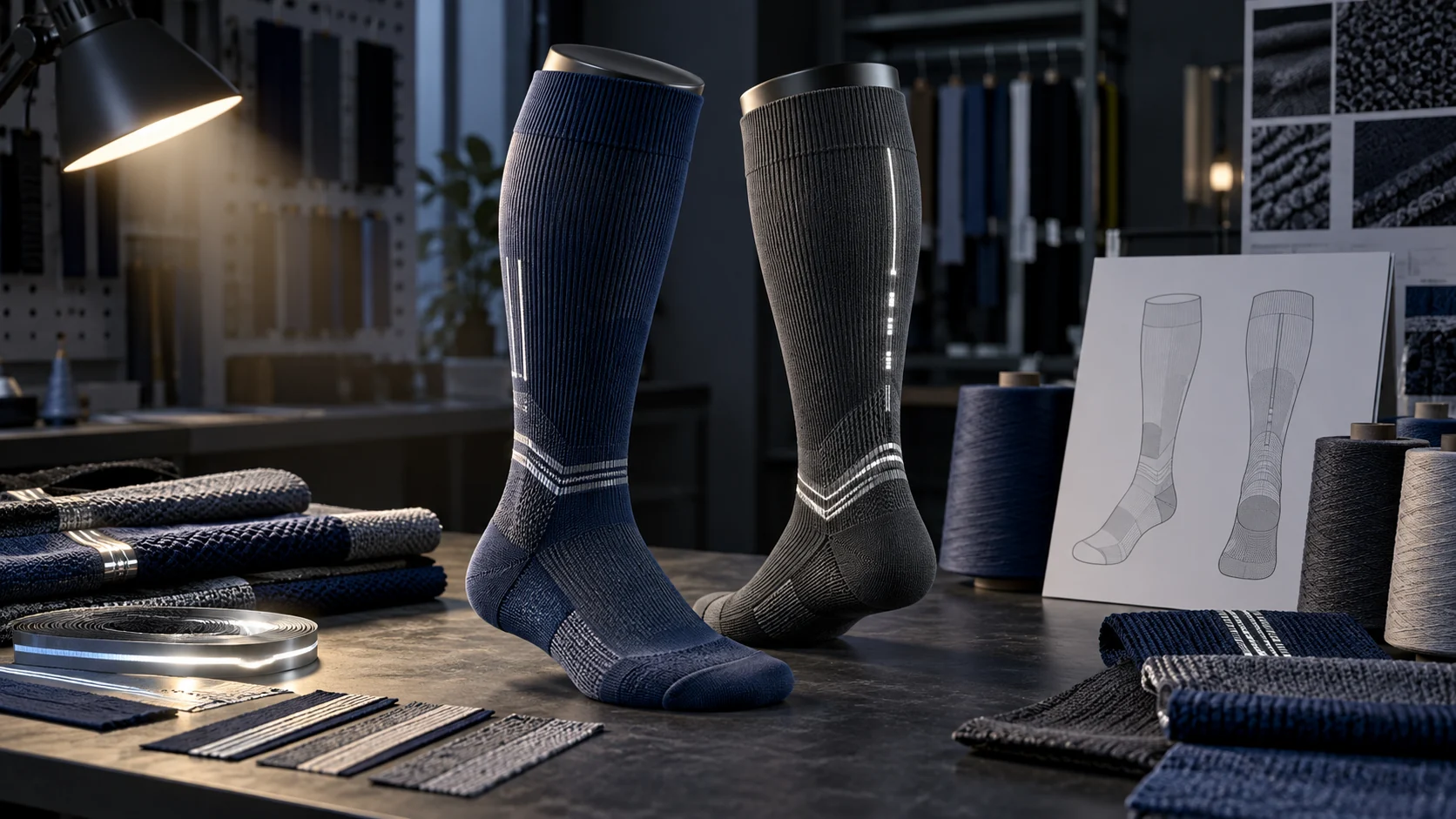
Concept visualization for product-development discussion. Confirm reflective material, placement, wash performance, compression and manufacturing feasibility before presenting this style as available, protective or certified.
Reflective details can help an athletic, workwear or travel-accessory range stand apart on the shelf, particularly when the design is subtle in daylight and more noticeable under directed light. For plus size compression socks, however, the effect has to work on a fabric that stretches across different ankle and calf measurements. A straight reflective line on a flat sample may look broken, distorted or uneven at the widest size boundary.
This guide helps brand owners, wholesalers and uniform buyers turn a visual idea into a measurable OEM brief. It also explains why a reflective design feature is not automatically personal protective equipment or a guarantee of wearer safety.
Start with the channel and intended design role
Define where the product will be sold and why the reflective element is included. An athletic collection may want a small back-calf accent, while a workwear retailer may prefer a restrained band that coordinates with uniforms. A fashion-led program may use reflective yarn only as a visual highlight.
Keep the wording aligned with evidence. “Reflective detail” describes a physical feature. “Improves safety” or “high visibility protection” makes a broader claim that may require product-level testing, standards review and market-specific approval. Do not present a sock as certified PPE without that evidence.
Compare reflective yarn, transfer and print options
Reflective effects can be introduced through specialty yarn, an applied transfer, print or another supplier-proposed method. Each option has a different relationship with stretch, surface feel, design resolution and laundering. Buyers should ask which method is feasible on the intended knit and request a sample made with the proposed bulk process.
Reflective yarn can be integrated into a pattern but may affect texture or knitting parameters. Applied elements can create sharper shapes but must flex with the sock and remain secure after use and care. A printed effect may offer another appearance, subject to compatibility with the base fabric and agreed test results.
Place details where stretch can be controlled
Map the design on a technical drawing and identify the measurement reference. Around the ankle, expansion and movement differ from the upper calf. On the back calf, a vertical detail may change width or spacing as the sock stretches. Near the cuff, the feature must not interfere with the cuff construction or create an uncomfortable edge.
Review placement on the smallest and largest planned sizes. Use forms or fit wearers near the upper calf boundary to check continuity, symmetry and visual alignment. Do not approve the artwork only on an unstretched sock laid flat.
Coordinate reflective artwork with wide-calf grading
The foot, ankle, calf, cuff and finished height should still be graded as a connected system. If a motif repeats around the leg, the repeat count or spacing may need to change by size. If the design has a fixed panel, its position should remain intentional relative to the ankle, heel and cuff.
Record both relaxed dimensions and fit measurements for the final sample. Check whether the reflective area restricts stretch or changes recovery compared with the surrounding fabric. For deeper assortment planning, use the color and pattern planning guide.
Protect comfort and footwear compatibility
An applied detail should not create a rough internal edge or a stiff transition where footwear rubs. Inspect the inside and outside of the sock, bend the ankle section and check the product in representative shoes or boots. Reflective features above the ankle still need to tolerate leg movement and repeated stretching.
Keep the feature away from areas where it could conflict with the toe closure, heel pocket or high-friction shoe zones unless that placement has been deliberately tested. Buyers developing an active range can also review the athletic compression socks category.
Define a test method before writing the claim
A smartphone flash demonstration can help a design review, but it is not a complete product specification. Agree how reflective performance will be evaluated, including light angle, distance, condition of the sample and any instrument or standard required by the buyer’s market. Document the method so the approved sample and bulk product can be compared consistently.
- Check the initial reflective appearance under the agreed conditions.
- Measure placement and alignment by size.
- Inspect adhesion, cracking, peeling or yarn damage after stretch.
- Repeat the agreed check after laundering and abrasion.
- Review dimensions, pressure and stretch recovery.
- Check inside comfort and transitions around applied areas.
- Retain an approved sample with the final artwork file.
Use the wash and stretch-recovery guide to structure repeat measurements.
Plan artwork for manufacturable detail
Very thin lines, tightly spaced dots and complex gradients may not reproduce consistently on a stretch knit. Ask for the supplier’s minimum practical line width, spacing and application area before finalizing artwork. Test the exact color combination because dark and light base yarns can change the daylight appearance of the feature.
A focused capsule can use navy, charcoal or black bases with one silver or muted reflective accent. This keeps the assortment suitable for athletic and uniform channels without turning every style into a high-contrast safety product.
Translate the approved sample into bulk quality control
The purchase specification should identify material method, artwork version, placement measurements, size grading, care instructions and test requirements. Bulk inspection can compare reflective continuity, symmetry, adhesion or yarn integrity, dimensions and appearance against the sealed sample.
Agree tolerances and defect classification before production. The bulk quality-control guide can support the wider plan. To discuss an OEM brief, submit the channel, design file, size range and intended claim through the quote form or review custom compression sock development.
FAQ
Are reflective compression socks personal protective equipment?
Not automatically. Do not present a decorative reflective detail as certified protective equipment without the required product-level evidence and approvals.
Which reflective method works best on a wide-calf sock?
It depends on stretch, design, washing, hand feel and manufacturing feasibility. Test the method on the final construction.
Can reflective placement change after the sock is stretched?
Yes. Wide-calf expansion can change spacing and alignment, so review the largest planned size under fit.
What should buyers test before bulk production?
Check reflectivity using an agreed method, placement, material integrity, stretch recovery, laundering, abrasion and comfort.