
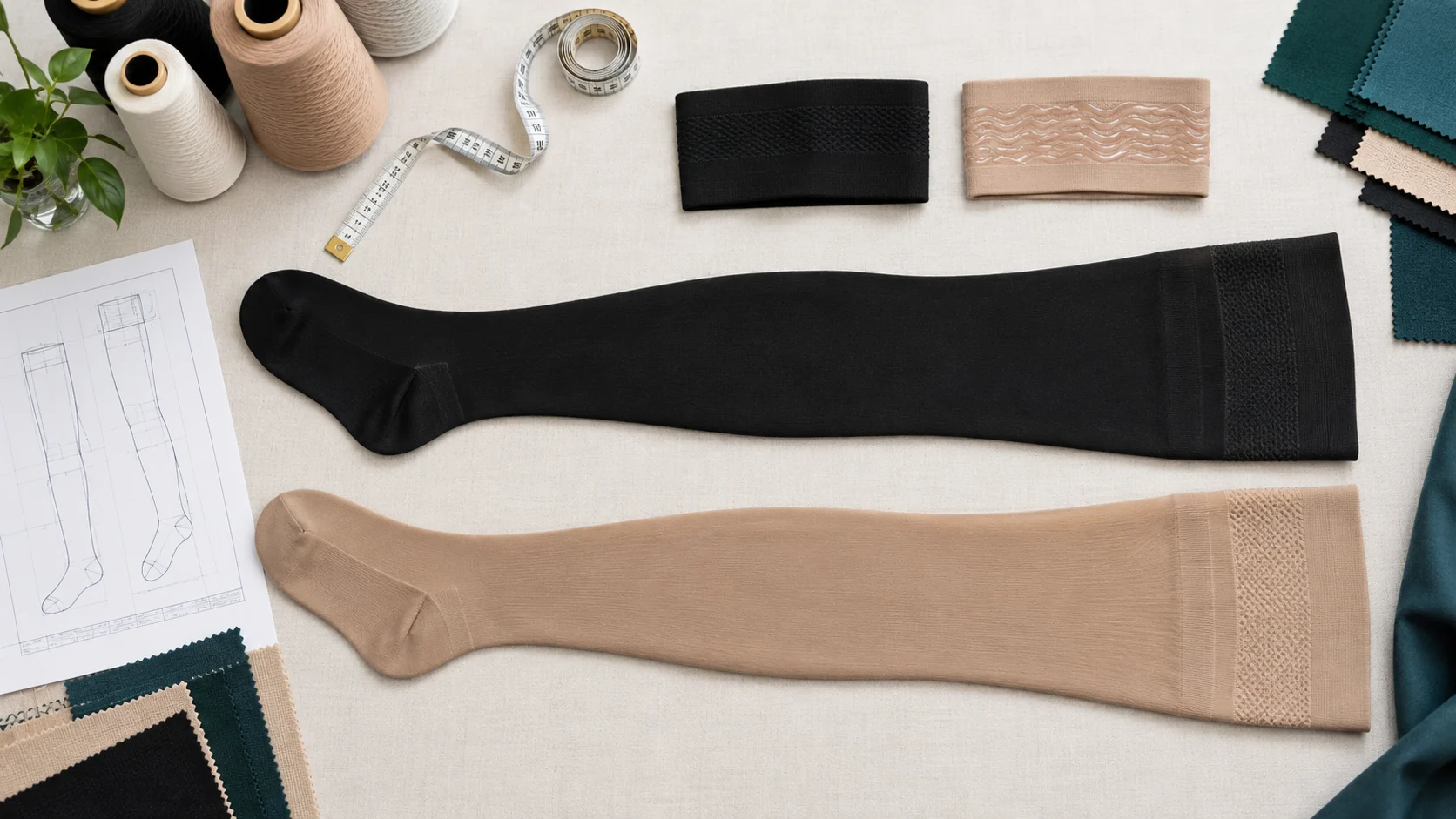
Concept visualization for product-development discussion. Confirm construction, compression, upper-band materials and manufacturing feasibility through approved physical samples.
A plus size thigh-high compression stocking is not simply a knee-high sock with extra fabric. It crosses the knee, follows changing thigh circumferences and finishes with a much wider band. Every transition affects fit, donning, stay-up behavior and the finished pressure profile.
Use a full-leg measurement map
Start with foot length, ankle and calf circumference, then add below-knee, knee, lower-thigh and upper-thigh circumferences. Define the vertical distance from the floor or heel reference to each measuring point, including the intended band position.
Body proportions vary. Two wearers with the same calf may need different thigh circumferences or lengths. Avoid asking one generic plus size to cover an excessively broad range. A matrix of circumference and length options may be more accurate than linear size labels.
Engineer the knee transition
The knee bends repeatedly and can expose problems that are not visible while standing. A stiff transition may feel restrictive, while excess length can collect behind the knee. During sampling, evaluate standing, sitting and normal walking and record wrinkles, migration and comfort.
Define where the pressure test points are located and how the knee zone relates to the rest of the stocking. Do not copy pressure results from a knee-high product to an extended construction.
Specify the upper-thigh band
The band must distribute hold over a larger, softer and more variable circumference. Record relaxed and stretched band dimensions, width, elastic structure and recovery. Fit-test at both ends of the intended thigh range rather than approving only the middle size.
A band that is too small can roll or feel restrictive; one that is too loose can migrate. The same principles described in the roll-down guide become even more important at thigh length.
Evaluate silicone grip as one component
Silicone strips or dots may add surface grip, but they cannot correct incorrect circumference, length or weak fabric recovery. Define grip layout, coverage, thickness and wash durability. Review skin-contact requirements and destination-market documentation before approval.
Compare grip and non-grip samples where practical. The silicone cuff guide provides a starting checklist, but a thigh band needs its own dimensions and wear trials.
Plan donning for the longer construction
More fabric and a wider measurement range can increase donning effort. Instructions should show how to position the heel and distribute the stocking gradually rather than pulling from the upper band. Test whether the package needs illustrated steps or a compatible donning aid.
Record where users experience the most resistance and whether the final band can be positioned flat. Our donning-friendly design guide explains how to separate a sizing problem from a construction or instruction problem.
OEM sample approval checklist
- Confirm the complete circumference and vertical measurement table.
- Measure foot, heel, ankle, calf, knee, thigh and band on each size.
- Verify the agreed pressure points and test method.
- Evaluate sitting, walking, knee bending and extended wear.
- Record band marks, rolling, sliding and fabric migration.
- Inspect silicone or other grip materials where used.
- Check donning, removal and heel alignment.
- Repeat dimensions, grip and recovery checks after laundering.
Bulk quality control
Retain an approved sample for every size and length. Bulk inspection should check overall length, key circumferences, knee placement, band width, grip layout, toe and heel construction, color and visible defects. Long products can twist or vary in alignment, so define a consistent flat-measurement method.
Packaging should identify the full size and length clearly. Include measurement instructions, fiber content, care, donning guidance and any destination-market labeling. Do not use medical or performance claims that have not been supported for the final product.
Questions to include in the RFQ
- Can the required upper-thigh circumference and length be produced on the proposed construction?
- Which band and grip options are available for sampling?
- How will pressure be tested across the extended leg?
- What size and length combinations are practical for the first order?
- Which tolerances will be used for the band, knee placement and total length?
Buyers can review our over-knee plus size compression socks, explore the custom program, or send a measurement brief through the quote form.
FAQ
What measurements are needed for plus size thigh-high stockings?
Add knee, lower-thigh, upper-thigh and full-length measurements to the normal foot, ankle and calf data.
Do silicone grip bands solve every stay-up problem?
No. Grip cannot correct unsuitable circumference, length, recovery or band comfort.
Can a knee-high chart be reused?
No. The extended leg and upper band require separate grading and fit trials.
Should samples be approved only on appearance?
No. Verify dimensions, pressure, comfort, movement, donning and wash recovery across the size boundaries.