
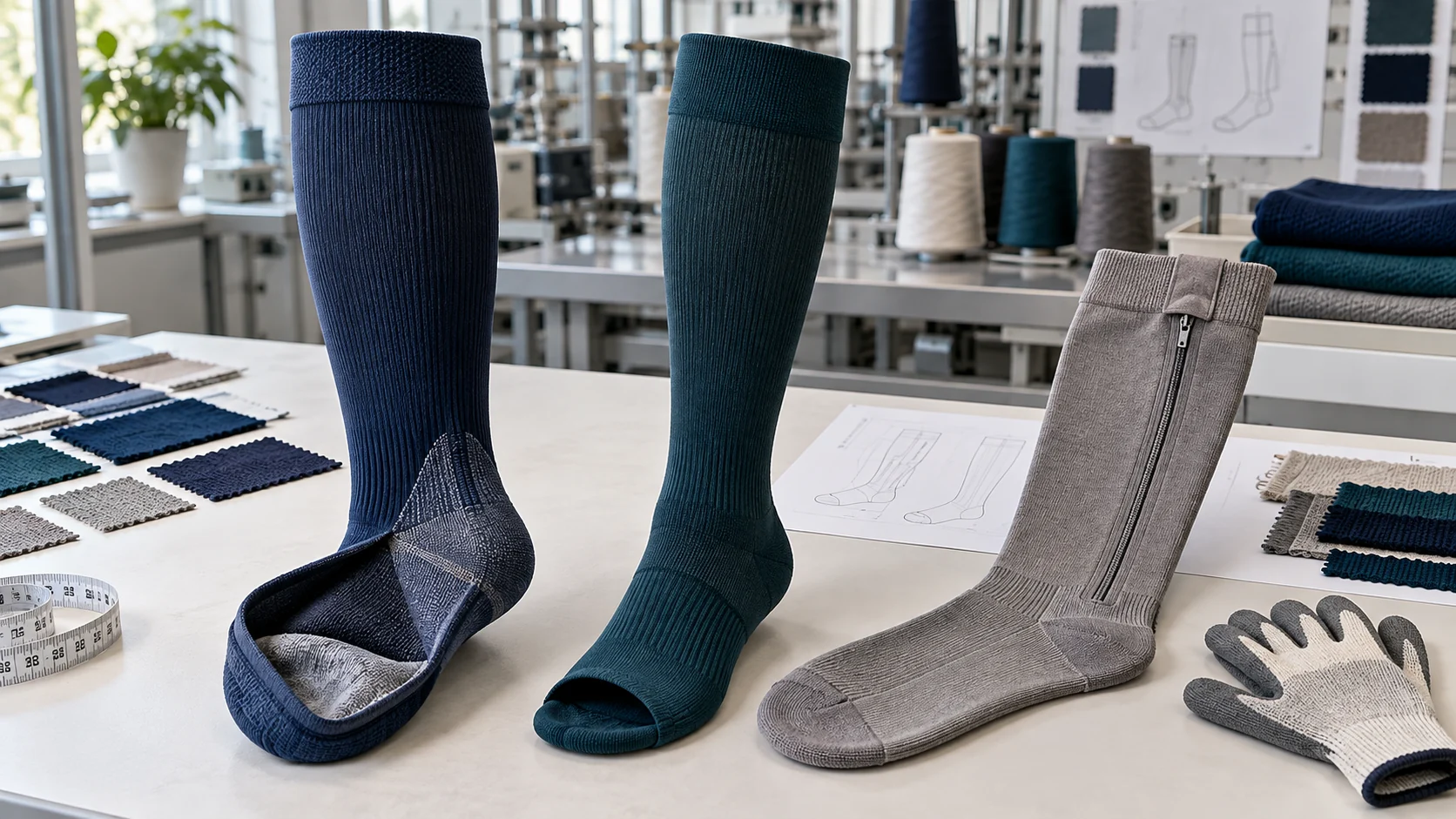
Concept visualization for product-development discussion. Confirm construction feasibility, compression and user experience in approved physical samples.
Difficulty putting on compression socks is a repeated customer concern, especially when the wearer has a wide calf, limited hand strength or a pattern that is tight at the ankle. For B2B buyers, “easy-on” should not be treated as a decorative feature or an untested marketing phrase. It is the result of compatible sizing, construction, donning method and target compression.
The design goal is to reduce avoidable effort without compromising the approved fit or performance specification.
Start by diagnosing why the sock is difficult
A sock may be difficult because it is the wrong size, the ankle transition is too narrow, the heel pocket is poorly shaped, the cuff is used as a pulling handle or the wearer has not been shown the recommended inside-out method. These causes need different solutions.
Ask trial users where the process stops: over the forefoot, around the heel, at the ankle or over the widest calf. Record removal as well as donning, because a sock that goes on acceptably may still be difficult to take off.
Correct sizing is the first easy-on feature
Do not try to solve a calf range that is too small by changing only the cuff or adding a zipper. Use foot, ankle, calf and heel-to-knee measurements to select or develop the grade. Customers with small feet and wide calves may need a combination size rather than a generally larger sock; see our small-foot, wide-calf grading guide.
The product page should explain that a larger shoe size is not a substitute for adequate calf capacity. A clear chart can prevent customers from receiving a sock that is structurally difficult because it is simply too small.
Design the heel pocket and ankle transition for the method
Many knee-high compression socks are donned by turning the leg portion inside out to the heel, positioning the foot and then gradually unrolling the fabric upward. A clearly shaped heel pocket helps the user know when the foot is seated correctly. If the heel is shallow or misplaced, users tend to pull harder from the cuff.
Review stretch through the heel diagonal and the transition above the ankle. The construction must open enough for the foot to pass while recovering to the approved fit. A soft hand feel alone does not prove that this balance is correct.
Compare closed toe, open toe and zipper constructions
An open-toe design can simplify forefoot positioning for some products and accommodates different toe preferences, but it still has to pass over the heel and ankle. A zipper design can open part of the leg, yet it adds a closure, inner guard, start position and new failure points. Neither is automatically best for every market.
- Closed toe: familiar appearance and full foot coverage; requires accurate toe and heel grading.
- Open toe: leaves toes exposed and may suit selected footwear or fit preferences; check the edge under tension.
- Zipper: can change the donning sequence; test skin protection, slider security, seam bulk and laundering.
Use the open-toe versus closed-toe guide and the zipper buyer guide when comparing specifications.
Do not make the cuff the pulling point
Users often grab the top band because it is visible and easy to hold. Repeated pulling can stretch the cuff unevenly and leave tension concentrated in one area. Packaging should show how to distribute fabric gradually along the leg and finish with the cuff flat rather than folded.
For limited hand strength, consider whether textured donning gloves or a compatible donning aid belongs in the product ecosystem. The buyer should test the sock with the proposed aid instead of assuming universal compatibility.
Balance stretch, recovery and specified pressure
A more extensible yarn or adjusted knit may reduce peak effort, but every change can affect recovery, fit, opacity and measured pressure. Compare candidate samples made to the same size and use objective test methods alongside wearer feedback.
If the sales channel needs multiple compression levels, develop and validate each construction separately. Do not describe a firmer sock as equally easy to apply without evidence from the final product and target users.
Run a repeatable donning and removal trial
Create a simple protocol and use it for every sample revision. Include participants near the lower and upper measurement limits and, where appropriate, users who report reduced grip or hand comfort. Do not ask participants to continue if a trial causes pain or creates a safety concern.
- Record the fitting method and whether instructions were viewed first.
- Time donning and removal without turning the exercise into a speed contest.
- Note the point of highest effort and whether assistance was needed.
- Check heel alignment, ankle wrinkles, cuff position and fabric distribution.
- Repeat after laundering to identify changes in stretch or recovery.
- Separate fit complaints from hand-effort and instruction problems.
Write claims that match the evidence
Terms such as “easy-on” and “effortless” can create unrealistic expectations when the target user and method are undefined. Safer factual descriptions include a protected side zipper, open-toe construction, wide-calf size range or illustrated donning instructions—provided each description matches the approved sample.
Avoid implying medical suitability or guaranteed independence. Buyers should complete the regulatory and claims review required for their destination market.
OEM sample brief and quality checklist
- Define the target wearer measurements and compression specification.
- Identify the current point of donning difficulty.
- Specify closed toe, open toe, zipper or accessory options to compare.
- Set heel, ankle, calf, cuff and length measurements with tolerances.
- Document the pressure test and wear-trial method.
- Inspect zipper guards, seams and hard points where applicable.
- Approve instructions, claims and packaging with the physical sample.
- Check dimensions and donning experience after laundering.
To discuss a development program, review our plus size compression socks, explore custom compression options, or send the size and construction brief through the quote and sample form.
FAQ
Can compression socks be made easy to put on?
Donning effort can often be reduced through correct sizing, heel and ankle design, suitable stretch, clear instructions or alternate constructions. The final sock must still meet its agreed specification.
Is a zipper always the easiest option?
No. Zippers help some users but add construction and durability requirements. Open-toe styles or donning aids may suit other users and channels.
What should a donning trial record?
Record the method, time, assistance, hand effort, heel alignment, wrinkles, cuff position and removal experience across representative users.
Can a brand claim easy-on without testing?
Avoid absolute claims unless the final construction has been evaluated with a defined method and target user group.