
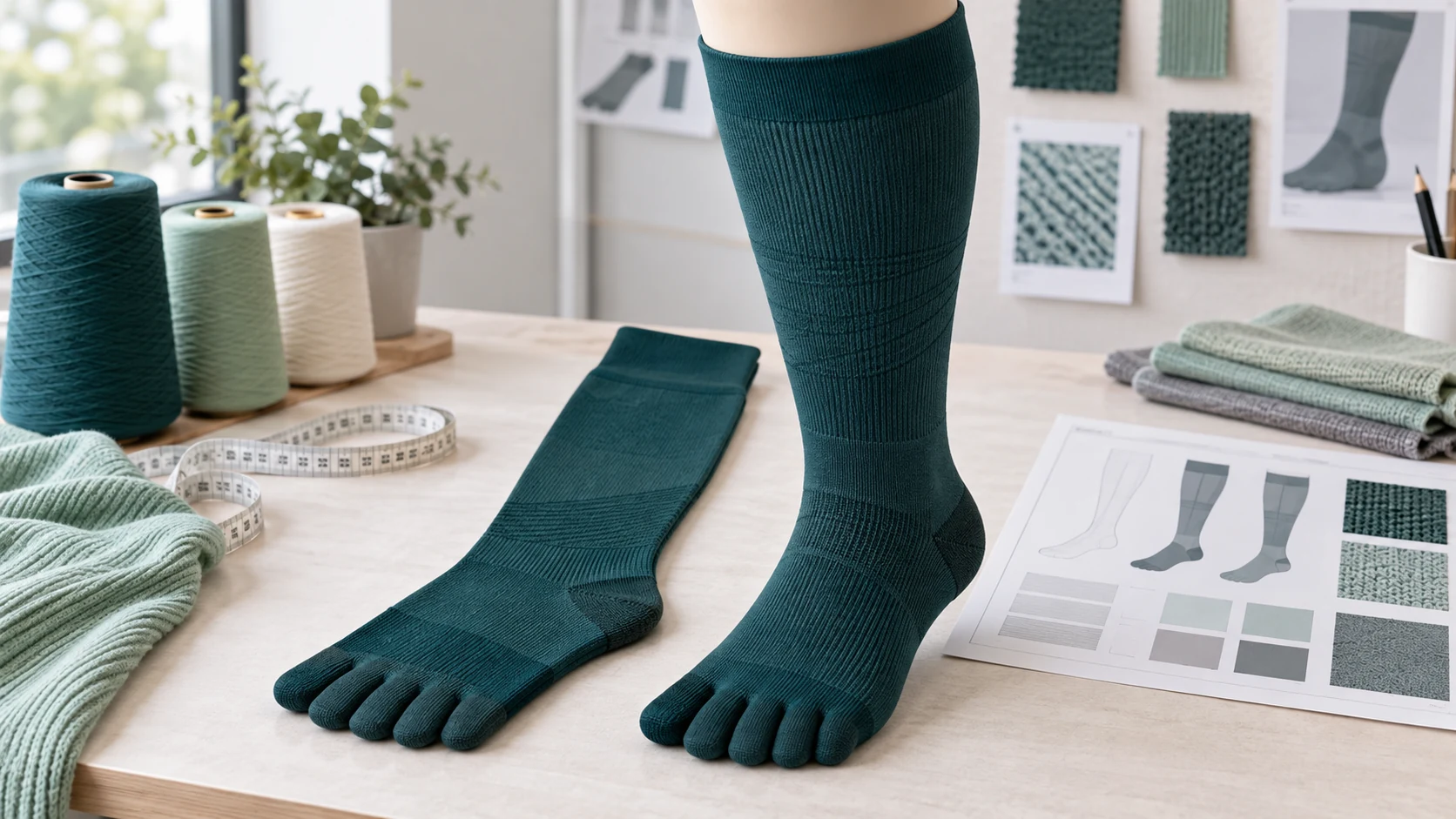
Concept visualization for product-development discussion. Confirm manufacturing feasibility, final construction and sample appearance before presenting this style as available.
Five-toe plus size compression socks combine two fit challenges in one product: individual compartments for every toe and a graded knee-high body for larger feet, ankles and calves. For a B2B buyer, this is not simply a standard compression sock with a different toe shape. It needs a separate specification, sample plan and quality-control checklist.
This guide focuses on product development for brands, distributors and private label sellers. It does not assume that a five-toe style is already in stock or that one construction will fit every market. Buyers should confirm equipment, knitting method, available yarns, minimum order and testing options with the supplier before launch.
What is a five-toe compression sock?
A five-toe sock covers each toe in its own knitted sleeve. That makes it different from a conventional closed-toe sock, where all toes share one toe box, and from an open-toe compression sock, where the toes remain exposed.
The individual-toe format can create a distinctive product story for specialty wellness, studio, travel and lifestyle channels. However, the buyer should position it as a construction and fit choice. Comfort, moisture and medical statements require separate evidence and should not be inferred from the appearance of the toe compartments.
Why plus size five-toe grading needs extra measurements
A standard wide-calf size chart normally coordinates foot length, ankle circumference, calf circumference and sock length. A five-toe version also needs forefoot width, toe spacing and toe-length allowances. Scaling every toe sleeve by the same percentage can create excess fabric on smaller toes or pressure at the big toe.
Ask for measurement data from the intended wearer group rather than relying only on shoe size. Shoe sizing systems vary by market and do not describe toe shape or forefoot width well enough for a new five-toe pattern.
- Foot length and forefoot circumference.
- Big-toe length and circumference.
- Second-toe length, including markets where it may exceed the big toe.
- Allowance for the third, fourth and fifth toe compartments.
- Ankle, calf and below-knee circumference.
- Heel-to-knee length and target cuff position.
For an inclusive range, review the smallest and largest foot within every calf size. A buyer may need more than one foot pattern even when two products share the same calf grade.
Map compression separately from the toe construction
The compression body and individual toe compartments should be treated as connected but separate engineering zones. Buyers need to define where the measurable compression range begins, how the forefoot transitions into the ankle and whether the toe sleeves are intended to provide light stretch rather than a stated compression value.
Do not copy pressure claims from a standard closed-toe sample without checking the finished five-toe construction. Changes in foot width, toe shaping, yarn tension and transition zones can affect fit. Agree on the pressure test method, test points, size condition and acceptance range before bulk production.
Toe seams, yarn ends and wearer comfort
Five separate compartments create more edges and finishing points than one conventional toe box. During sampling, turn the sock inside out and inspect every toe for bulky joins, loose yarn ends, uneven shaping and hard transitions. Compare left and right socks for toe order and length consistency.
The smallest toe sleeve deserves particular attention because it has limited space for finishing. A sleeve that is too narrow may feel restrictive, while one that is too long may fold. The big-toe sleeve should also be checked during walking and inside the footwear expected in the target channel.
For related construction checks, use the toe seam and cuff guide as a baseline, then add five-toe-specific inspection points.
Material selection for individual toe compartments
The yarn must balance stretch, recovery, abrasion resistance and a smooth hand feel. A soft yarn may improve initial touch but lose shape after repeated wear, while a dense high-recovery construction may feel bulky inside shoes. Buyers should approve the finished sock rather than selecting yarn from a swatch alone.
Moisture-management or cooling yarn can be considered for warm-weather positioning, but these functions require their own specification and tests. The existing cooling fabric plus size compression socks guide explains why cool touch, breathability and moisture movement should be evaluated separately.
What to include in an OEM sample brief
- Target country, sales channel and intended footwear.
- Full foot, toe, ankle, calf and leg-length measurement table.
- Compression range, test method and measurement locations.
- Yarn composition, color, opacity and wash-care requirements.
- Toe-sleeve length and width tolerances for each size.
- Heel reinforcement, arch structure, cuff type and logo position.
- Left and right sock identification if the pattern is foot-specific.
- Packaging diagram or fitting instructions for the end customer.
Ask the supplier to identify any requirement that needs special programming or equipment before confirming price or timing. Five-toe construction may have different development and production constraints from standard wide-calf socks.
Sample approval and wear-trial checklist
Approve more than appearance. Run fitting checks across the intended foot and calf range, including wearers near each size boundary. Record whether each toe reaches the end of its sleeve without pulling the heel forward or creating folds.
- Confirm all five toe sleeves are present, correctly ordered and symmetrical.
- Measure toe length, forefoot width, foot length, ankle, calf and sock height.
- Inspect internal joins, loose ends and thickness between the toes.
- Check heel placement and the transition from forefoot to ankle.
- Verify cuff stability without relying on excessive tightness.
- Test the agreed compression points on every planned size.
- Repeat dimensions, appearance and recovery checks after laundering.
- Test the sock with representative shoes from the target channel.
Bulk quality control for five-toe socks
Bulk inspection should include a toe-by-toe check rather than treating the foot as one zone. The inspection sheet can record missing or twisted toe sleeves, mixed left and right socks, uneven toe lengths, skipped stitches, exposed yarn ends and inconsistent heel placement.
Set tolerances before production. If a toe dimension is critical, define the relaxed measurement method and acceptable variation. Keep the approved sample, size specification and packaging artwork under the same revision number so production and inspection teams use the same reference.
Packaging and customer instructions
Five-toe socks may need clearer fitting instructions than conventional compression socks. A simple diagram can show how to align each toe before gradually pulling the body over the ankle and calf. Do not make unverified health claims on the package; keep the wording focused on construction, size, material and care.
For a first wholesale program, a focused color range and limited number of size combinations can make sampling and quality control easier. Collect wearer feedback before expanding the assortment.
Questions to send with an RFQ
- Can your current equipment produce five individual toe compartments in the required yarn?
- Which foot and toe measurements are needed for pattern development?
- Can the finished style be tested to the buyer's compression specification?
- What sample stages are recommended before a full size run?
- What MOQ, sample timing and bulk lead time apply to this special construction?
- Which defects and dimensional tolerances will be included in bulk inspection?
Buyers can compare the broader custom compression sock program, review wide-calf sizing, or submit a five-toe development brief through the quote and sample form.
FAQ
How are five-toe compression socks different from open-toe compression socks?
A five-toe style covers each toe separately. An open-toe style leaves the toes exposed. They use different patterns and require different fit checks.
Can a regular plus size sock chart be reused for a five-toe style?
Not by itself. Retain the ankle, calf and length data, then add forefoot width, toe length and toe-circumference allowances for the intended wearer range.
Are five-toe plus size compression socks automatically available as a stock product?
No. Confirm machinery, programming, material, MOQ, sample timing and test feasibility before presenting the style as available.
Should a five-toe design be marketed with medical claims?
Not without appropriate evidence and market-specific regulatory review. Use factual construction, sizing and material descriptions that match the approved product.