
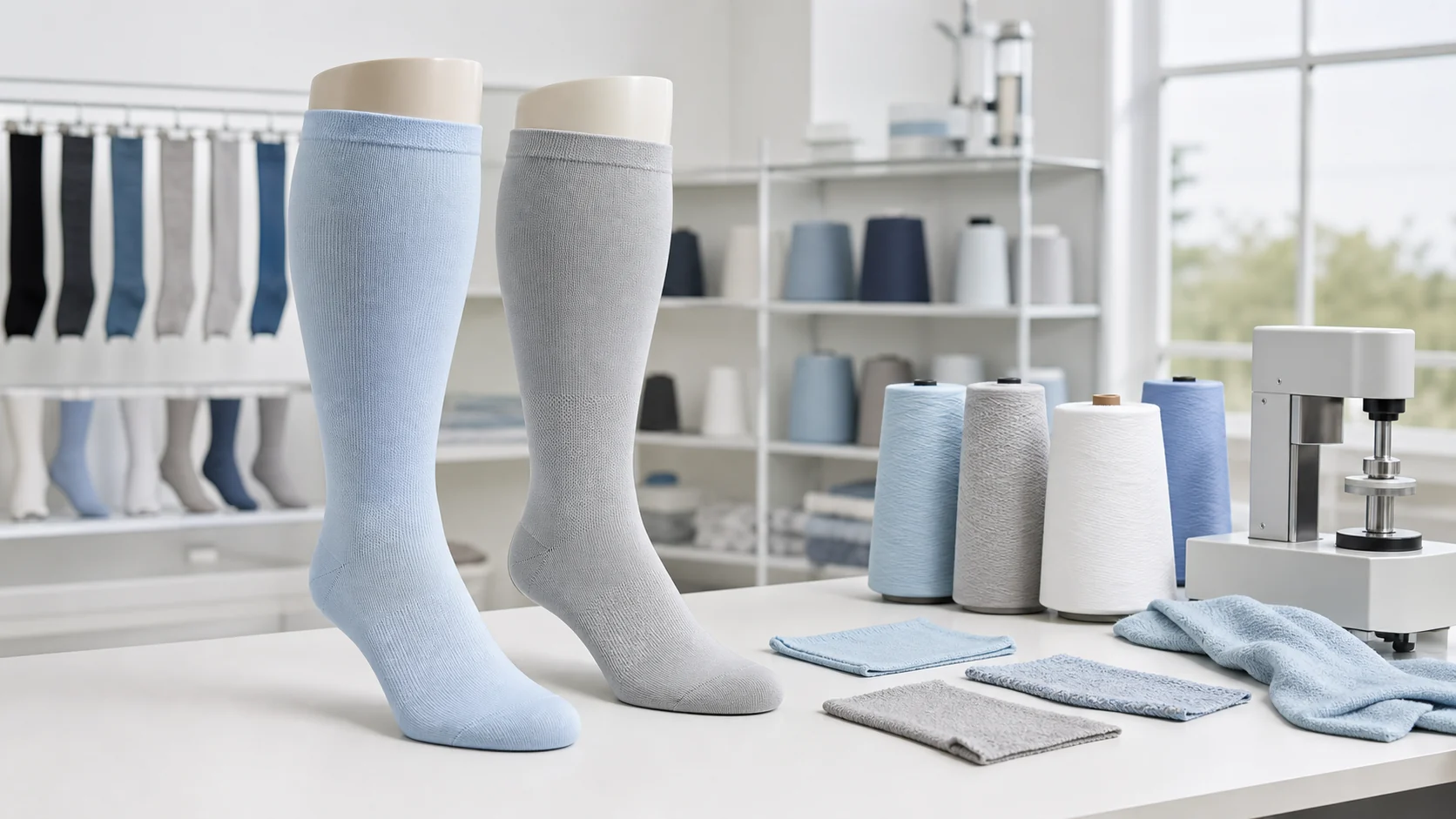
Cooling fabric can be a useful product direction for summer collections, travel ranges, workwear and warm-climate markets. For a wholesale buyer, however, the word cooling is not a complete specification. The sock still needs measurable wide calf sizing, stable compression, suitable opacity and durable recovery.
A reliable development brief separates cool-touch sensation, moisture movement, air permeability and drying behavior. These properties can work together, but they are not interchangeable. The final claim should match the finished sock rather than a general yarn description.
What does cooling fabric mean in a compression sock?
Cool-touch fabric is designed to move heat away from the skin quickly at first contact. The result is often expressed as q-max, the maximum heat flux measured during a controlled contact test. JIS L 1927 provides a method for evaluating the cool-touch property of textiles.
Moisture management is a separate question. AATCC TM195 evaluates liquid moisture management in textile fabrics. Buyers may also request drying, air permeability or wear tests according to the destination market and sales claim.
A fabric may feel cool at first touch but hold moisture during long wear. Another fabric may wick moisture well without creating a strong initial cool sensation. Decide which consumer problem the product is intended to solve before choosing yarn.
Cooling material options for private label development
There is no single universal cooling yarn. Suppliers may offer modified nylon or polyester yarns, high-filament constructions, shaped fibers or mineral-containing systems intended to improve heat transfer or moisture movement. Buyers should request the exact composition, yarn specification and available test report.
The support yarn and elastane remain important. Replacing too much structural yarn with a softer or lighter cooling yarn can reduce recovery, change opacity or make pressure less consistent. A practical sample often uses the cooling component in selected body zones while retaining stronger yarns around the ankle, heel, toe and cuff.
Bamboo-derived viscose can provide a soft hand feel, but it should not automatically be described as cooling. The final performance depends on yarn blend, knit density, finishing and the amount of stretch on the wearer's leg.
Why plus size construction needs separate testing
Wide calf compression socks operate over a larger circumference and a broader size range. When the fabric stretches, the knit opens, colors appear lighter and the cooling material occupies a different surface area. These changes can affect opacity, hand feel and compression performance.
Do not approve a 2XL-7XL line from a single average-size mannequin. Confirm foot length, ankle circumference, calf circumference and knee-high length for every planned size. Test both the smallest and largest measurements within each range.
The cuff should also be reviewed in warm conditions. A lighter body fabric combined with a heavy cuff can trap heat or leave marks, while an overly soft cuff may roll down. Material selection and calf grading need to be approved together.
What buyers should put in the sample brief
- Target country, climate, season and end-use scenario.
- Required fiber composition and acceptable substitutions.
- Target foot, ankle, calf and leg-length measurements.
- Compression specification and the agreed test method.
- Cool-touch, moisture, drying or air-permeability claims to validate.
- Color, opacity, logo, cuff, toe and packaging requirements.
- Care instructions and the number of wash cycles for comparison.
Testing cooling performance before a bulk order
Ask the supplier whether a q-max result applies to raw fabric, a flat knitted panel or the finished sock. Results from different laboratories, temperature differences or conditioning procedures should not be compared without checking the method. The buyer and factory should agree on one protocol and approval target.
Moisture and drying tests should be supported by realistic wear trials. Review how the sock feels after extended use, whether the upper remains comfortable, whether the foot becomes damp and whether light colors become transparent over the widest calf.
After laundering, compare dimensions, cuff recovery, compression, pilling and color. AATCC TM135 is one recognized method for evaluating dimensional change after home laundering, while the buyer can define additional finished-sock recovery checks.
Cooling claims for packaging and online listings
Use specific wording that can be supported. Phrases such as cool-touch yarn, moisture-management construction or lightweight summer knit are clearer than absolute promises such as stays cold all day. Keep the supporting report and approved sample connected to the exact SKU, color and size construction.
For online stores, explain the difference between initial cool touch and long-wear moisture comfort. A short care guide can also reduce complaints because fabric softener, high heat and incorrect drying may affect functional yarns or elastane.
OEM sample approval checklist
- Verify the declared yarn composition and supplier documents.
- Record q-max or other agreed cooling-test results.
- Check moisture management and drying where claimed.
- Measure compression and dimensions across the size range.
- Inspect opacity and color on the widest target calf.
- Wear-test cuff comfort in warm conditions.
- Repeat appearance and recovery checks after laundering.
- Approve all customer-facing claims before packaging production.
Commercial planning for a first order
Start with a focused assortment. Black, navy, light gray and one seasonal color can cover core and summer demand without creating excessive inventory. A small test order can compare a cooling version with the brand's standard wide calf construction.
Keep size grading, compression level and packaging consistent where possible so the cooling material is the main variable. This makes reviews and reorder data easier to interpret.
Buyers can compare related styles in Our Products, review wide calf compression socks and private label compression socks, or read our guide to breathable summer compression socks.
FAQ
Is cool-touch fabric the same as breathable fabric?
No. Cool-touch describes initial heat transfer at skin contact. Breathability and moisture management are different properties and should be specified separately.
How can buyers test a cooling claim?
Agree on a laboratory protocol such as JIS L 1927 and record the q-max result for the finished construction. The test conditions and sample type should be shown with the result.
Can one cooling fabric be used across 2XL-7XL sizes?
It may be possible, but every size range should be checked for stretch, opacity, compression and recovery rather than approved from one sample.
Does bamboo fiber automatically make a compression sock cooling?
No. Bamboo-derived fibers may provide softness, but cooling performance must be supported by the final blend, knit construction and relevant testing.