
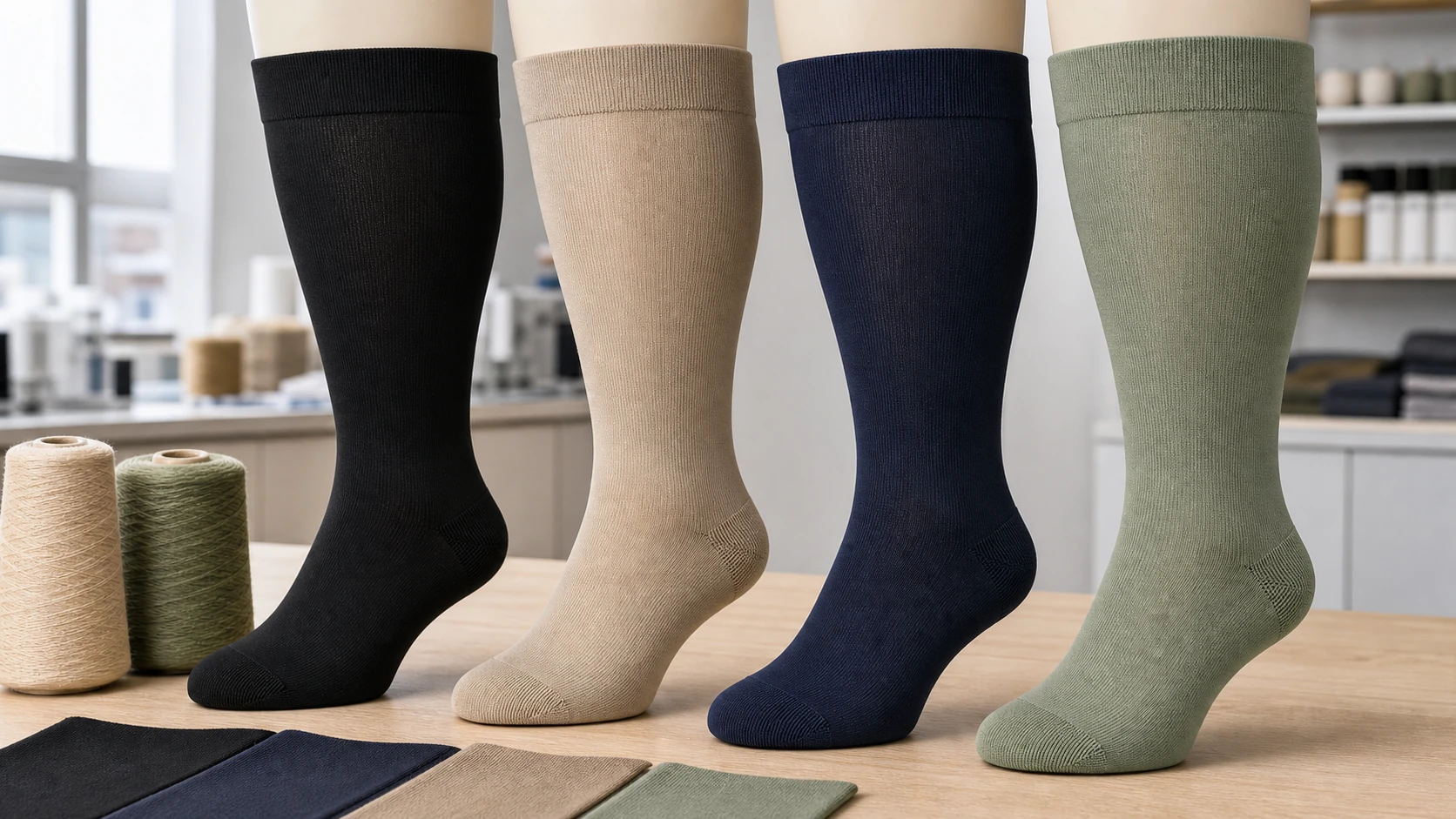
Why bamboo compression socks attract wholesale buyers
Bamboo compression socks have a product story that customers understand quickly: soft touch, everyday comfort and a fabric direction that feels different from a basic synthetic compression sock. When this material story is combined with a true plus size construction, the product can serve an underserved group of customers who need more room through the calf and a more comfortable top band.
For wholesalers, distributors and online stores, this makes bamboo plus size compression socks useful as a core comfort SKU rather than only a seasonal novelty. The product can sit inside workwear, travel, nursing, wellness and daily-wear collections. It also gives private label brands a simple way to separate a premium comfort line from their regular compression sock assortment.
However, the word bamboo by itself does not make a product successful. A strong-selling item still needs accurate wide calf sizing, consistent compression, stable recovery after washing, practical colors and packaging that explains the fit clearly.
Softness is the first selling point, but fit closes the sale
Customers may first notice the bamboo material claim, but they usually decide whether to keep the product based on fit. Standard compression socks can feel restrictive on larger calves, and a narrow cuff may roll, dig into the leg or become difficult to pull on. A plus size program should therefore be developed around actual ankle and calf measurements, not simply a larger shoe size.
Buyers should define the widest calf circumference for every size, together with ankle circumference, foot length and finished sock height. This is especially important for products marketed as wide calf compression socks or extra wide compression socks.
A wider top opening must still recover well enough to stay in place. During sampling, buyers should examine cuff stretch, pressure distribution and the transition between the cuff and the calf body. The goal is a secure fit without relying on a narrow, aggressive top band.
Understand what “bamboo fiber” means in compression hosiery
Most bamboo compression socks are not made from one fiber alone. The bamboo component is commonly bamboo-derived viscose blended with nylon, polyester, spandex or other elastic yarns. The supporting yarns help provide stretch, compression, durability and shape recovery.
B2B buyers should request the actual material composition and should avoid approving a product based only on a marketing name. A higher bamboo content may change softness, thickness, drying behavior, abrasion resistance and knitting stability. The correct blend depends on the target compression level, wearing season, price point and expected wash life.
For a useful material comparison, review our compression sock materials guide. Private label buyers planning material claims can also use the existing bamboo fiber private label guide.
Choose a practical compression level for the target channel
The compression level should match the intended sales channel and the documentation available for the destination market. A comfort-oriented daily line may use a lighter graduated compression direction, while specialist retail or medical supply channels may request a different specification.
Buyers should confirm how pressure is tested, where the measurement is taken and what production tolerance will be used. Do not rely only on the printed mmHg value. The same label can feel different when calf grading, yarn tension and construction are changed.
Any medical or therapeutic statement should be reviewed for the destination market before it appears on packaging or marketplace listings. For general B2B positioning, clear descriptions of material, fit, construction and intended daily use are more reliable than unsupported treatment claims.
A simple bamboo plus size bestseller assortment
A new wholesale program does not need too many SKUs. Buyers can start with a compact assortment that covers the most practical choices and expand after receiving sales and return data.
- One knee-high closed toe construction as the main everyday style
- Black and beige as the first two core colors
- Navy or gray as a third workwear-friendly option
- A clearly measured extended size range based on ankle and calf circumference
- One single-pair package and one value-pack option for online channels
After the core line is stable, brands can add an open toe version, muted seasonal colors or a patterned style. It is usually better to build sales history around a few well-supported items than to launch many colors before sizing and customer feedback are proven.
How to plan 2XL-7XL sizing without confusing customers
Labels such as 2XL, 4XL or 7XL do not have a universal measurement standard. Two factories may use the same size name for very different calf ranges. For that reason, the size chart should show numeric measurements and explain how the customer should measure.
At minimum, each size should state ankle circumference, calf circumference and foot size. Sock length can also help customers choose between sizes when height differences are significant. The chart should use the units expected in the target country and should appear on the product page, package and customer service reference sheet.
Before finalizing the range, compare the proposed grading with the guidance in our plus size compression socks size chart article. A broader size range is valuable only when each size has been sampled and measured consistently.
What makes a bamboo compression sock suitable for repeat orders
Repeat business depends on consistency. The second production batch should match the approved sample in yarn composition, color, calf measurement, cuff stretch, sock length and compression feel. Buyers should agree on measurable tolerances before bulk production instead of relying on visual approval alone.
Wash and recovery testing are particularly important for bamboo blends. Samples should be checked before washing and after repeated wash cycles for shrinkage, twisting, surface change, loss of elasticity and color transfer. Toe seam comfort, heel placement and the appearance of the cuff should also be reviewed across the full size range.
For wholesale inspection, use a signed sample, measurement table, packaging artwork and approved color reference. These documents make it easier to resolve differences before shipment.
How online stores should present the product
A strong product page should answer fit questions before it repeats general fabric benefits. Show the widest calf range near the top of the page, then explain the material blend, compression specification, cuff construction, size chart and care instructions.
Useful images include a full product view, fabric close-up, cuff stretch detail, size-chart graphic, packaging view and color comparison. Lifestyle images can support the page, but they should not replace clear product evidence. Buyers should also make sure models or mannequins visibly represent the intended wide calf fit.
Keep the sales message straightforward: soft-touch bamboo blend, extended calf sizing, stable graduated compression construction and practical daily colors. This is more credible and easier to translate across wholesale markets.
OEM sample checklist for wholesale buyers
- Exact bamboo blend composition and yarn specification
- Target pressure level and test method
- Ankle, calf, foot and sock-length measurements by size
- Cuff opening, stretch range and recovery requirement
- Toe style, seam construction and reinforced heel details
- Core colors, logo method and packaging artwork
- Care label, barcode, size sticker and carton-mark requirements
- MOQ, sample timing, production lead time and inspection standard
Buyers who need OEM development can review the bamboo fiber plus size compression socks product program and submit the target calf range, compression level, colors and packaging plan for sampling.
Final recommendation
Bamboo plus size compression socks can become a reliable wholesale bestseller because they combine two clear customer needs: a softer comfort story and better room for wide calves. The strongest product is not simply a regular sock made larger. It is developed as a coordinated system of material blend, calf grading, cuff structure, pressure control and easy-to-understand packaging.
Start with a small set of core colors and a validated size chart. Approve the full size range through physical samples, document the compression and recovery standards, and expand only after the first sales data confirms which sizes and colors deserve more inventory.
FAQ
Why are bamboo plus size compression socks a strong wholesale product?
They combine a clear soft-comfort material story with demand for wide calf sizing, daily-wear colors and practical knee-high compression styles. Commercial performance still depends on correct sizing, stable compression and reliable quality control.
Are bamboo compression socks made from 100 percent bamboo fiber?
Usually not. Compression socks commonly use a blended construction that may combine bamboo-derived viscose with nylon, polyester, spandex or other elastic yarns. Buyers should confirm the exact composition with the manufacturer.
What sizes should a plus size bamboo compression socks line include?
The size range should be based on ankle, calf, foot and leg-length measurements rather than labels alone. Many buyers plan an extended range such as 2XL through 7XL, but the measurement table must be validated through samples.
What should buyers test before placing a bulk order?
Buyers should review material composition, calf fit, cuff comfort, compression consistency, wash recovery, colorfastness, toe seam, packaging and size-label accuracy before bulk approval.