
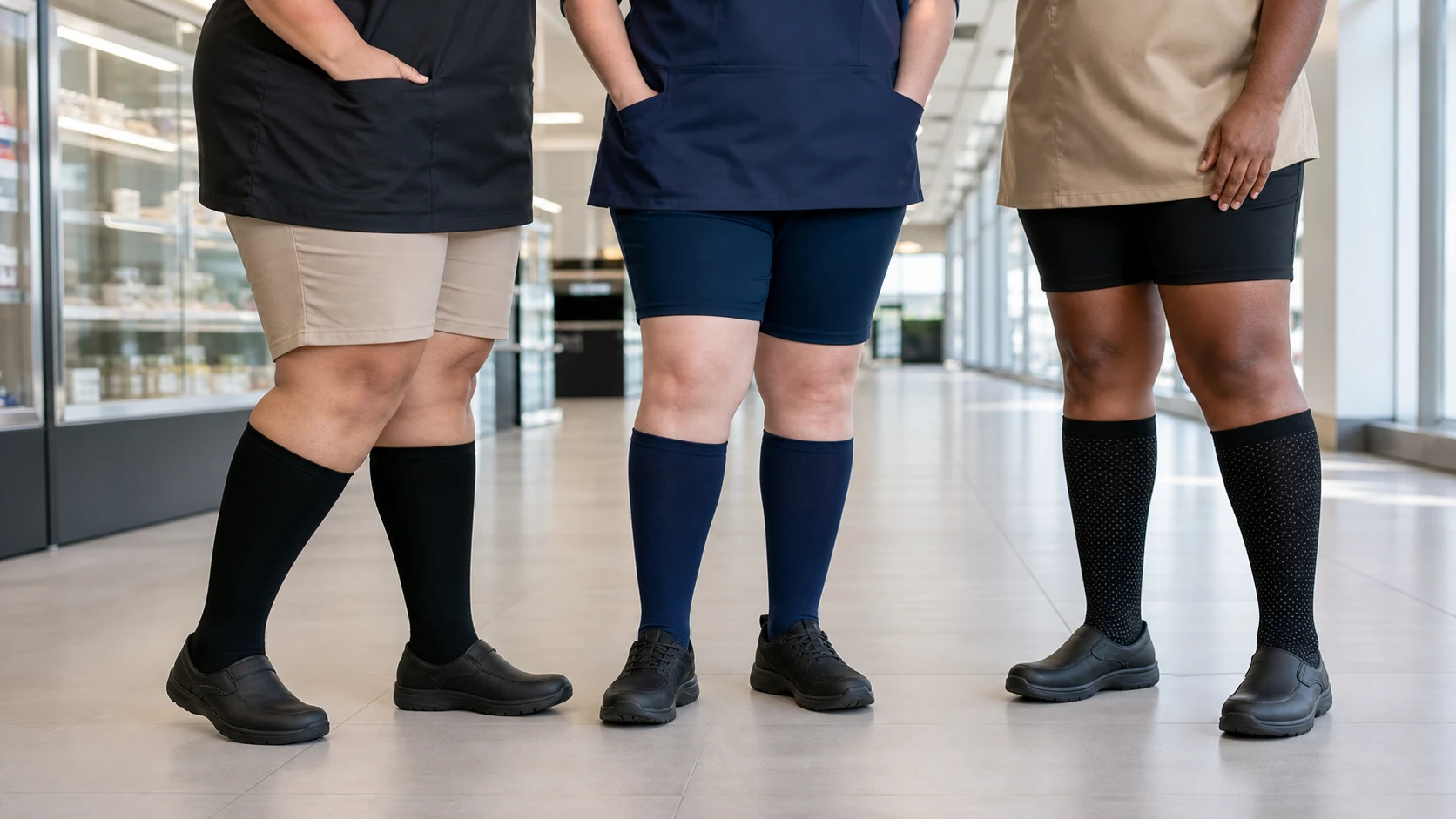
Standing workers need products that fit into real uniforms, footwear and shift routines. For plus size customers, a tight cuff or difficult donning experience can become more important than decorative styling.
Wholesale buyers should define the occupation, footwear, climate and dress code before selecting materials and colors. The product can then be tested for the movements and wearing time expected in that channel.
What buyers should define before sampling
A complete brief gives the factory a measurable target and reduces revisions. Confirm these points before treating a sample as ready for approval:
- Target occupations and uniform requirements.
- Calf, ankle, foot and leg-length ranges.
- Daily-wear compression and claim strategy.
- Material, ventilation and durability needs.
- Core colors and workplace styling.
- Care instructions for frequent washing.
Fit the product to the work environment
Healthcare, hospitality, retail and industrial workers use different footwear and uniforms. Closed toe styles may suit many work shoes, while breathable zones or lighter constructions may support warm environments.
Test the sock with the actual footwear type. Toe seams, thickness and leg length can affect comfort during a long shift.
Prioritize cuff stability and easy sizing
Workers need a sock that remains in place without a narrow top band digging into the calf. Wide cuff construction and accurate grading should be wear-tested during walking, standing and sitting.
Uniform buyers also need a simple chart. Too many overlapping sizes make distribution and employee ordering difficult.
Plan for frequent care
Work socks may be washed often, so buyers should test dimensional stability, recovery, color and surface appearance. Care instructions must be practical for the user group.
A multi-pair or three-pack option can support rotation and reduce the pressure on one pair, but the pack should keep size and care information visible.
Sample approval checklist
Use the approved sample as a production reference, not only a sales photo. Record the results of the following checks and retain the final version:
- Wear-test through a representative shift.
- Check fit with intended work shoes.
- Observe cuff position during movement.
- Wash-test for the expected care routine.
- Confirm uniform color matching.
- Review employee-facing size instructions.
OEM and commercial planning
For B2B workwear accounts, provide a concise size guide, product specification, care sheet and sample set. Neutral colors support broad uniform use, while channel-specific patterns can be developed for healthcare or branded programs. Avoid medical outcome promises unless properly supported.
Buyers can compare related styles in Our Products, review private label compression socks capability and share their target sizes, quantities and packaging through the contact form.
Common mistakes to avoid
- Selecting the style without considering work shoes.
- Using a narrow cuff on a broad calf range.
- Ignoring frequent washing.
- Providing a complicated employee size process.
- Making unsupported health claims.
Final recommendation
Design for the full shift: fit, footwear, movement, washing and uniform appearance. A practical workwear program is easier for distributors and employers to adopt.
Specifications and claims should be confirmed for the product, sales channel and destination market before ordering or publishing customer-facing materials.
FAQ
Which workers are common target customers?
Healthcare, hospitality, retail, warehouse, salon and other roles with extended standing can be relevant channels.
What colors are suitable for uniforms?
Black, navy, beige and white are common, but buyers should match the employer's dress code.
Should socks be tested with work shoes?
Yes. Thickness, toe seam and foot fit can change when worn inside the intended footwear.
Are multi-packs useful for workers?
They can support daily rotation and value, provided all pairs use the same approved size and performance specification.