
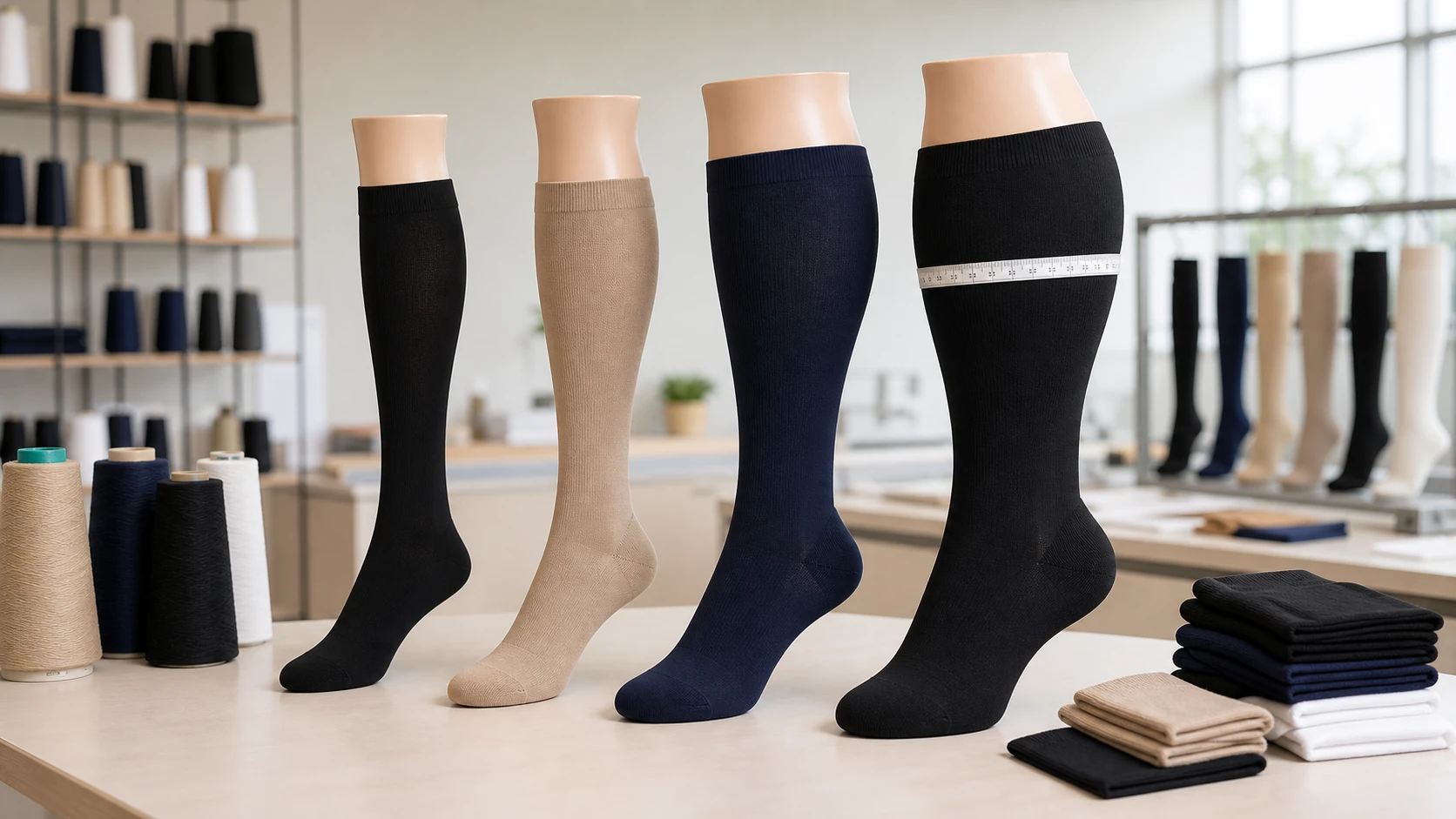
A 55-70 cm calf program serves a demanding fit segment that standard wide calf products may not cover. The target range is broad, and a single sock cannot automatically fit every wearer in it with the same ankle stability, cuff comfort and compression feel.
Buyers should approach this category as a dedicated product-development project. The body range, number of sizes, compression target, leg length and donning expectations need to be agreed before yarn and artwork decisions.
What buyers should define before sampling
A complete brief gives the factory a measurable target and reduces revisions. Confirm these points before treating a sample as ready for approval:
- Exact calf bands within the 55-70 cm target market.
- Matching ankle ranges for each calf band.
- Foot and leg-length ranges by size.
- Target compression level and destination-market requirements.
- Top-band width, elasticity and anti-roll construction.
- Donning aids or zipper options if the concept requires easier use.
Split a broad range into workable sizes
A range from 55 to 70 cm should normally be studied as several fit bands instead of one universal size. Dividing the range helps the sock maintain a closer ankle fit and reduces extreme stretching at the cuff.
The correct number of sizes depends on the product structure and target compression. Buyers should request sample data that shows how finished dimensions, elastic recovery and pressure change across the proposed bands.
Engineer the cuff for comfort and stability
The cuff has to hold the sock in place without concentrating pressure on a narrow line. A wider top band, suitable elastic distribution and enough vertical length can improve stability, but these features still need wear testing.
Extra-wide styles should be checked for rolling, folding and skin marking at the largest target calf. A cuff that looks comfortable on a mannequin may behave differently after several hours on a moving wearer.
Be precise with product claims
Use measured calf ranges and verified compression information instead of vague statements such as fits everyone. Packaging and online listings should explain the measurement method and show which range each size covers.
Medical or therapeutic claims can trigger additional regulatory and documentation requirements. Buyers should obtain qualified advice for the destination market and align any claims with actual testing.
Sample approval checklist
Use the approved sample as a production reference, not only a sales photo. Record the results of the following checks and retain the final version:
- Fit-test each proposed calf band at its lower and upper boundary.
- Check ankle looseness when the calf is at the top of the range.
- Record donning and removal difficulty.
- Wear-test the cuff for rolling and concentrated pressure.
- Recheck stretch recovery after washing.
- Confirm that packaging uses the tested 55-70 cm ranges accurately.
OEM and commercial planning
Extra-wide styles can be positioned as a focused extension rather than mixed silently into a regular assortment. Give distributors a clear size chart, measurement diagram and sample set. For e-commerce, explain the difference between wide calf and extra-wide calf products so customers can self-select more accurately.
Buyers can compare related styles in Our Products, review private label compression socks capability and share their target sizes, quantities and packaging through the contact form.
Common mistakes to avoid
- Using one universal size for the complete 55-70 cm range.
- Enlarging only the cuff while leaving the ankle unchanged.
- Approving the product without wear testing at the upper boundary.
- Making unsupported medical or one-size-fits-all claims.
- Printing packaging before final pressure and fit checks.
Final recommendation
Treat 55-70 cm as a specialist range with its own grading and validation. Clear size bands and realistic claims are more valuable than an oversized label with no tested fit system.
Specifications and claims should be confirmed for the product, sales channel and destination market before ordering or publishing customer-facing materials.
FAQ
Can one compression sock fit calves from 55 to 70 cm?
It may be technically possible in some constructions, but multiple size bands usually provide better ankle fit, cuff comfort and product consistency.
What is the main risk in extra-wide sizing?
The sock may become too loose at the ankle or excessively tight at the cuff when one pattern is stretched across a very broad range.
Should zipper styles be considered?
A zipper can support easier donning for some concepts, but zipper placement, protection and compression uniformity require separate sample testing.
How should the range appear on packaging?
Show the exact calf and ankle measurements for each size and include a simple measuring diagram.