
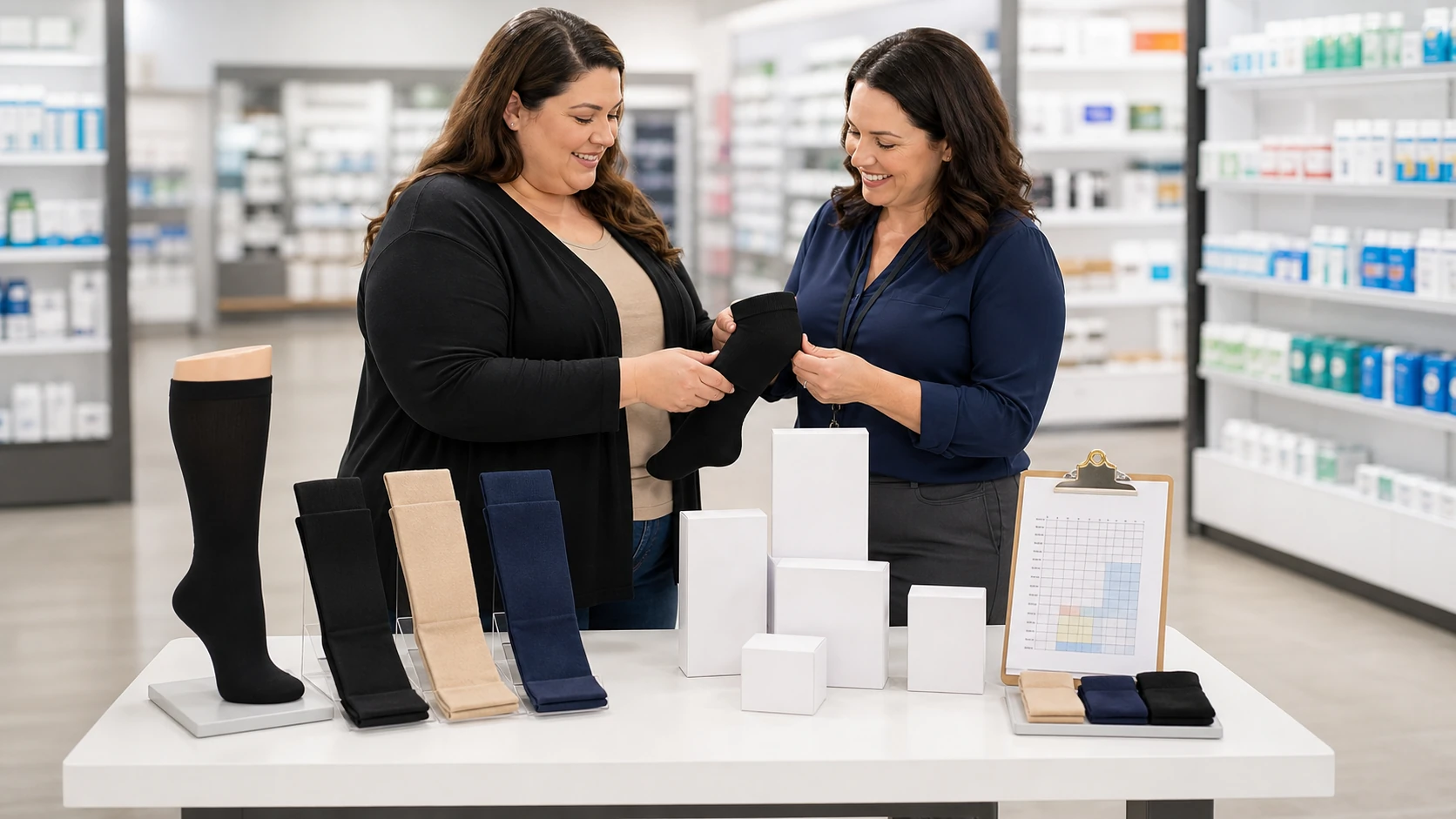
Pharmacy customers often expect clear, trustworthy guidance at the shelf. A plus size assortment therefore needs visible measurements, easy product differentiation and claims that match the product's evidence and market requirements.
Retailers also need manageable inventory. The assortment should cover meaningful calf ranges without creating confusing duplicate sizes or too many slow-moving color variants.
What buyers should define before sampling
A complete brief gives the factory a measurable target and reduces revisions. Confirm these points before treating a sample as ready for approval:
- Target customer and permitted retail positioning.
- Calf, ankle and foot ranges shown clearly.
- Compression specification and supporting documentation.
- Shelf-ready packaging and barcode needs.
- Staff sizing and product-comparison materials.
- Replenishment plan by size and color.
Create a shelf-readable size system
Customers should see the size, calf range, toe style and compression specification without opening the package. Use a consistent color or code system, but keep the actual measurements readable.
Provide a simple measuring diagram that pharmacy staff can explain. Shoe size alone is not enough for wide calf selection.
Build a focused assortment
Start with neutral closed toe styles and add open toe, zipper or extra-wide options where the customer base supports them. Avoid filling the shelf with near-identical variants.
Review sales by size, not only total style. Larger edge sizes may move slowly but can be essential to the channel promise.
Support responsible customer guidance
Packaging and staff materials should distinguish product specifications from medical advice. Customers with health concerns may need to consult a qualified professional.
Keep claims, warnings and instructions aligned with destination-market requirements. A B2B supplier can provide product data, but the retailer owns how the product is presented.
Sample approval checklist
Use the approved sample as a production reference, not only a sales photo. Record the results of the following checks and retain the final version:
- Review packaging from normal shelf distance.
- Test barcode and shelf-label compatibility.
- Confirm chart readability for staff and customers.
- Check that product variants are visually distinct.
- Review claims with qualified market guidance.
- Fit-test the largest advertised calf range.
OEM and commercial planning
Provide pharmacies with a small sample kit, size guide and product comparison sheet. Replenishment data should identify size and color so buyers can protect availability in the ranges that customers cannot easily find elsewhere.
Buyers can compare related styles in Our Products, review private label compression socks capability and share their target sizes, quantities and packaging through the contact form.
Common mistakes to avoid
- Using vague plus size labels without measurements.
- Overloading the shelf with colors before fit demand is known.
- Making staff rely on shoe size.
- Using unsupported medical claims.
- Dropping edge sizes only because their volume is lower.
Final recommendation
Win pharmacy trust with clarity: measured fit, responsible wording, readable packaging and dependable replenishment.
Specifications and claims should be confirmed for the product, sales channel and destination market before ordering or publishing customer-facing materials.
FAQ
What styles should a pharmacy range start with?
Neutral knee-high closed toe styles are a practical base, with open toe, zipper or extra-wide options added according to demand.
What information should staff receive?
A measuring diagram, size chart, product comparison and guidance on when customers should seek professional advice are useful.
Why keep low-volume edge sizes?
They may be essential for customers who cannot use standard ranges and can strengthen the retailer's specialist positioning.
Can packaging make medical claims?
Claims must be supported and reviewed for the destination market. Buyers should obtain qualified regulatory guidance.